


After wet material is put into one end of the drier, the material is evenly distributed and dispersed in the drier under the turning of the plate transcriber which is evenly distributed in the inner cylinder, and the wet material is in full contact with the hot air of cocurrent (countercurrent), which speeds up the drying heat transfer and transfers to the driving force.
After wet material is put into one end of the drier, the material is evenly distributed and dispersed in the drier under the turning of the plate transcriber which is evenly distributed in the inner cylinder, and the wet material is in full contact with the hot air of cocurrent (countercurrent), which speeds up the drying heat transfer and transfers to the driving force. During the drying process, the material can move to another section of star discharge valve of the dryer to discharge the finished product.
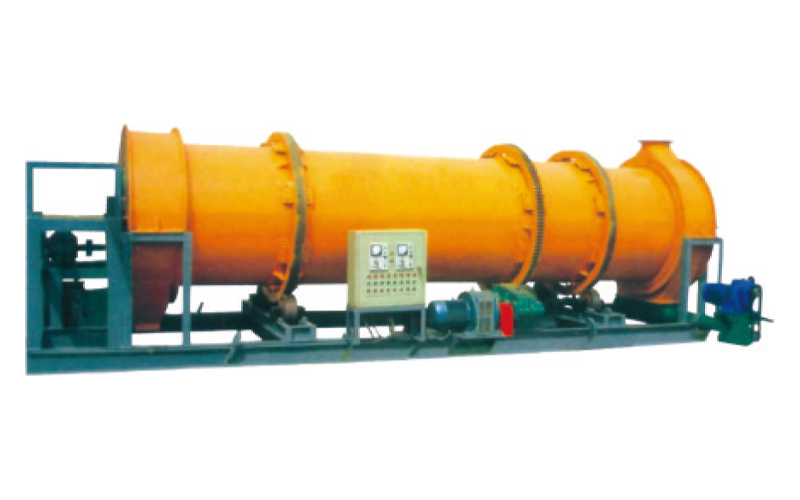
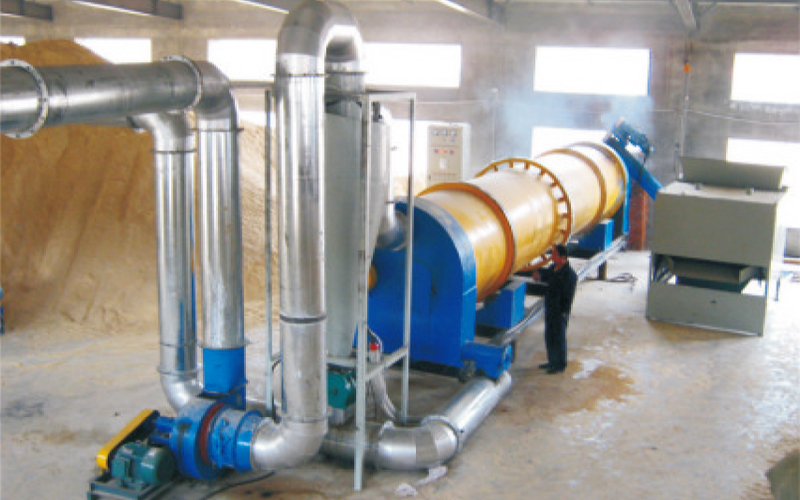
● The Rotary Dryer has a high degree of mechanization and production capacity.
● The fluid through the cylinder body resistance is small, the function consumption is low.
● It has strong adaptability to material characteristics.
● Stable operation, low operating cost, good product drying uniformity.
1. Chemical, mining, metallurgy and other industries large particles, the proportion of dry materials, such as: Mines, blast furnace slag, coal, metal powder, phosphate fertilizer, ammonium sulfate.
2. For the drying of powder and granular materials with special requirements, such as: HP foaming agent, Lees, light calcium carbonate, active clay, magnetic powder, graphite, drug residue.
3. Require low temperature drying, and continuous drying of large quantities of materials.
| Model | Unit | Direct heating clockwise way | Direct heating clockwise way | Direct heating counterclockwise way | Direct heating counterclockwise way | Compound heating | Compound heating |
| Type of material | Ore | HP vesicant | Slag of blast furnace | Ammonium sulphate | Hphosphorus fertilizer | Coal | |
| Mount to be treated | kg/h | 1000 | 466 | 15000 | 20000 | 12000 | 5000 |
| primary content of water | % | 30 | 13 | 6 | 1.5 | 5 | 6.5 |
| Fina content of water | % | 15 | 0.3 | 1 | 0.1 | 0.1 | 0.1 |
| Average diameter | mm | 6.5 | 0.05 | 4.7 | 0.5–1.7 | 0.5 | 5 |
| Bulk density of raw material | kg/m³ | 770 | 800 | 1890 | 1100 | 1500 | 750 |
| Amount of hot air | kg/h | 39000 | 5400 | 10750 | 9800 | 6500 | 16000 |
| Temperature of air at inlet | ℃ | 600 | 165 | 500 | 180 | 650 | 570 |
| Temperature of raw material at outlet | ℃ | 42 | 100 | 70 | 80 | 75 | |
| Way of heating | Gas | Stream, electric heating | Heavy oil | Coal fuel hot air furnace | Heavy oil | Heavy oil | |
| Filling coefficient | % | 6.3 | 7 | 7.5 | 7.8 | 18 | |
| Revolution | r.p.m | 4 | 4 | 3.5 | 3 | 4 | 2 |
| Gradient | m/m | 0.04 | 0.005 | 0.03 | 0.05 | 0.05 | 0.043 |
| Diameter of drier | 12 | 24 | 12 | 22 | Outer surface 8 of the inner cylinder, inner surface 16 of the outer cylinder | Outer surface 6 of the inner cylinder, inner surface 12 of the outer cylinder | |
| Amount of blade | m | 2.0 | 1.5 | 2 | 2.3 | Inner cylinder 0.84, outer cylinder 2 | Inner cylinder 0.95, outer cylinder 2.4 |
| Length of drier | m | 20 | 12 | 17 | 15 | 10 | 16 |
| Power of driving | kw | 22 | 7.5 | 15 | 11 | 11 | 15 |