


The heat consumption of blade is low: No heat carried out by the air because of indirect heating; there's no heat insulation layer with the exterior wall of the dryer. It consumes 1. 2kg of steam to evaporate 1kg of water for to drying slurry state of material.
● The heat consumption of blade is low: No heat carried out by the air because of indirect heating; there's no heat insulation layer with the exterior wall of the dryer. It consumes 1. 2kg of steam to evaporate 1kg of water for to drying slurry state of material.
● The cost of the blade dryer is low: The unit effective volume has very large heat transferring surface, so the processing time is shorted, the size of the equipment becomes small. The building area and place are sharply decreased.
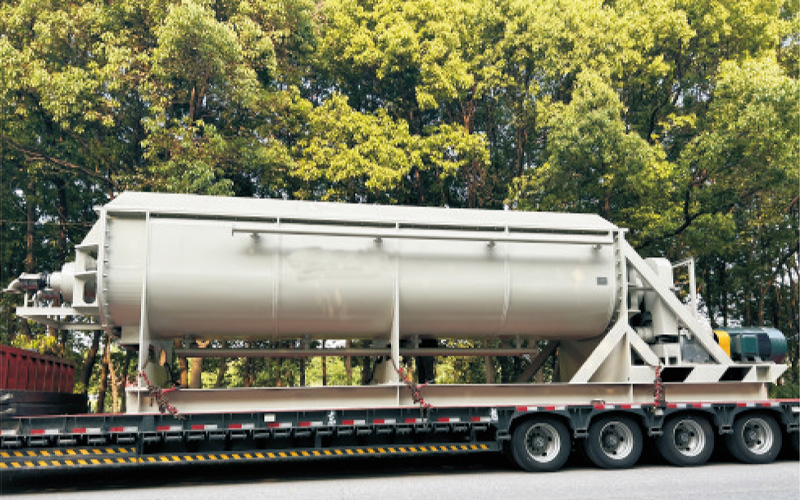
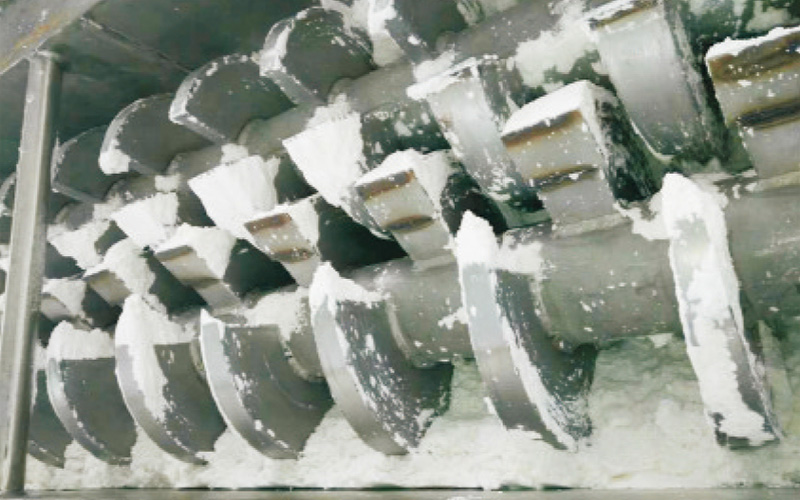
● The range of material to be processed is wide: Heat sensitive material and the materials to be processed under high temperature might be processed with different heating media. The normal media are: steam, thermal oil, hot water and chill water. It might be continuous or batch operation, widely used in many areas.
● The pollution is less: Without any carrying air, very few powder is carried out. The solvent evaporated is very few, it easy to be processed. For the material that might cause pollution or the solvent to be recovered, it might adopt sealed circulation.
● The operation cost is low: 1hour/day. operator is enough for normal operation. Low stirring speed and reasonable structure, the worn amount is few, and the maintenance fee is low.
● Steady operation: The material particles fully contact heat transferring surface, because of the special compressing and swell-stirring effect of the chock shaped blade. The difference of the temperature, humidity and mixing effect are very small in the different axial area, so to ensure the stability of process.
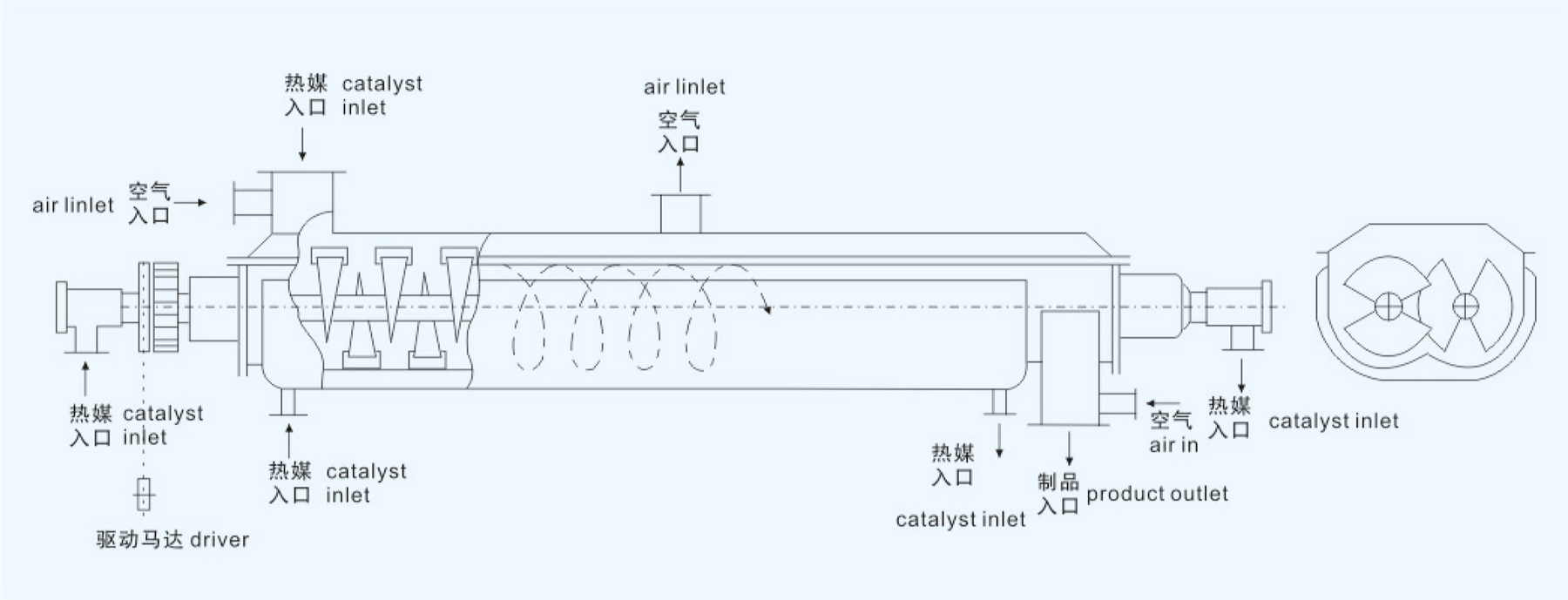
The blade dryer is successfully applied in foodstuff, chemical, petrochemical, dyestuff, and industrial mud etc. The heating transferring, cooling and stirring characters enable it to perform the following unit operation: combustion ( low temperature), cooling, drying (recovery of solvent), heating (melting), reacting and sterilizing. The stirring blade is heat transferring surface too, so to increase heat transferring area of unit effective volume is increased, and decrease processing time. The chock shaped heat transferring surface has self-cleaning function. Compressing and swell-stirring functions make the material mixed uniformly. The material perform the movement of "piston flow" along the shaft. The difference of the temperature, humidity and mixing effect are very small in the different axial area. The blade dryer is capable to perform combustion under low temperature if we adopt thermal oil as heating media, such as Ca₂SO₄ · 2H₂O is combusted into Ca₂SO₄ · 1/2H₂O, NaHCO₃ is combusted into Na2CO₃ and so on. It's capable for cooling process with water and chill salted water etc, such as base cooling machine in Na₂CO₃ industry, instead of the old style base air cooler, so to save power and the processing equipment to tail air, and save operation cost. Drying is the main function of this machine. Drying without hot air makes the process of solvent recovery, energy consumption, control of environment ideal, easy to teat. It's specially applicable for recovery of solvent and heat sensitive material that is easy to be combusted or oxidized. It has been widely used in fine chemical, petrochemical, and dyestuff industries. The uniformity of t emperature, humidity and mixing effect in axial areas make the equipment capable for heating and melting, or reaction of solid material. It;s successfully applied in mixed fertilizer and character transformed starch industries. The blade dryer is also capable for sterilizing food and starch. The big heating area in unit effective area, dry the material to sterilizing temperature very fast, so to avoid quality change caused by long time heating.
| Model \ Item | KJG-3 | KJG-9 | KJG-13 | KJG-18 | KJG-29 | KJG-41 | KJG-52 | KJG-68 | KJG-81 | KJG-95 | KJG-110 |
| Heat transferring area (m²) | 3 | 9 | 13 | 18 | 29 | 41 | 52 | 68 | 81 | 95 | 110 |
| Effective volume (m³) | 0.06 | 0.32 | 0.59 | 1.09 | 1.85 | 2.8 | 3.96 | 5.21 | 6.43 | 8.07 | 9.46 |
| Range of rotating speed (r.m.p) | 15–30 | 10–25 | 10–25 | 10–20 | 10–20 | 10–20 | 10–20 | 10–20 | 5–15 | 5–10 | 5–10 |
| Power (kw) | 2.2 | 4 | 5.5 | 7.5 | 11 | 15 | 30 | 45 | 55 | 75 | 95 |
| Width of vessel A(mm) | 306 | 584 | 762 | 940 | 1118 | 1296 | 1474 | 1652 | 1828 | 2032 | 2210 |
| Total width B(mm) | 736 | 841 | 1066 | 1320 | 1474 | 1676 | 1854 | 2134 | 1186 | 2438 | 2668 |
| Length of vessel C(mm) | 1956 | 2820 | 3048 | 3328 | 4114 | 4724 | 5258 | 5842 | 6020 | 6124 | 6122 |
| Total length D(mm) | 3972 | 4876 | 5486 | 5918 | 6808 | 7570 | 8306 | 9296 | 9678 | 9704 | 9880 |
| Distance of material inlet & outlet E(mm) | 1752 | 2540 | 2768 | 3048 | 3810 | 4420 | 4954 | 5384 | 5562 | 5664 | 5664 |
| Height of center F(mm) | 380 | 380 | 534 | 610 | 762 | 915 | 1066 | 1220 | 1220 | 1220 | 1220 |
| Total height G(mm) | 762 | 838 | 1092 | 1270 | 1524 | 1778 | 2032 | 2362 | 2464 | 2566 | 2668 |
| Steam inlet "N" | 3/4 | 3/4 | 1 | 1 | 1 | 1 | 11/2 | 11/2 | 11/2 | 11/2 | 2 |
| Water outlet "O" | 3/4 | 3/4 | 1 | 1 | 1 | 1 | 11/2 | 11/2 | 11/2 | 11/2 | 2 |