




Industrial drying is a critical process in chemical manufacturing, pharmaceutical production, food processing, and many other industries. It removes moisture or other volatile components from materials to achieve the required moisture content, product stability, storage performance, and downstream processing quality.
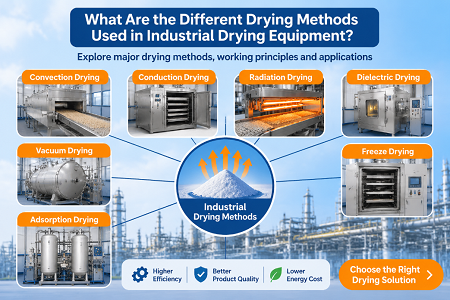
The main industrial drying methods include convection drying, conduction drying, radiation drying, dielectric drying, vacuum drying, and freeze drying. Adsorption drying is also widely used when moisture must be removed from compressed air or industrial gases. Each method has a different working principle, operating cost, and range of applications.
For manufacturers, selecting the right industrial drying equipment means balancing drying efficiency, product quality, production capacity, energy consumption, and process safety. Understanding the differences between drying methods is the first step toward choosing an appropriate drying solution.
1. What Are the Main Types of Industrial Drying Methods?
Industrial drying methods can be classified according to heat transfer, operating pressure, or moisture removal mechanism. These categories overlap: for example, a vacuum dryer can use conduction heating, while a freeze dryer combines freezing, vacuum, and sublimation.
The best drying method depends on the material's physical form, moisture content, heat sensitivity, production target, and required final quality. A method that works well for a liquid feed may not be suitable for a sticky paste or a heat-sensitive solid.
2. Convection Drying: A Versatile Method for Industrial Production
Convection drying is one of the most widely used industrial drying methods. It transfers heat from a heated gas, usually air, directly to wet material. Moisture evaporates from the material, and the gas stream carries the resulting vapor away.
Drying performance depends on inlet temperature, airflow, humidity, residence time, particle size, and the initial moisture content. Proper control of these parameters helps achieve the target moisture level while reducing the risk of overheating or uneven drying.
Common Convection Drying Equipment
Spray dryers: Spray drying converts a pumpable liquid, solution, suspension, or suitable slurry into droplets that contact heated gas. Rapid moisture evaporation produces powder or particulate products. Common applications include food ingredients, dairy products, chemical powders, and selected pharmaceutical materials.
Fluid bed dryers: These machines suspend suitable particles in an upward-flowing gas stream, improving gas-solid contact.They are often used for drying granules, pellets, and other particulate materials.
Belt dryers: Wet materials move through a drying chamber on a conveyor belt while heated air passes over or through the product. Belt drying is suitable for many food products, agricultural materials, and other materials that can be distributed in a controlled layer.
Flash dryers: A high-velocity hot gas stream rapidly dries suitable dispersed particles. This method is useful when short drying times are required and the material can be transported through the drying system.
Advantages and Limitations of Convection Drying
Convection drying offers broad material compatibility and can support continuous, large-scale production. However, direct exposure to heated gas may cause oxidation, surface hardening, dust generation, or thermal degradation in sensitive materials.
Before purchasing convection drying equipment, evaluate airflow distribution, temperature control, exhaust treatment, dust collection, heat recovery, and the required final moisture content.
3. Conduction Drying: Indirect Heat Transfer for Controlled Processing
Conduction drying, also called indirect drying, transfers heat through a solid surface such as a heated wall, tray, or jacket. The heating medium does not need to contact the product directly. Moisture evaporates from the heated material and is removed through an appropriate vapor-handling system.
Common Conduction Drying Equipment
Vacuum tray dryers: Materials are spread on trays inside a chamber. Heat is supplied through heated trays, shelves, or other designed surfaces. Vacuum operation can help reduce the temperature required for evaporation.
Vacuum rake dryers: A mechanical rake or agitator moves the material to improve surface exposure and heat transfer. Depending on the design, these dryers may process selected powders, pastes, and other materials that benefit from agitation.
Double cone rotary vacuum dryers: A rotating double-cone vessel tumbles and mixes the material while heat and reduced pressure support moisture removal. They are often considered for powders, granules, and other suitable materials.
Drum dryers: In suitable designs, wet material contacts a heated rotating surface, allowing moisture to evaporate before the dried product is removed.
When Should You Consider Conduction Drying?
Conduction drying is worth evaluating when direct contact with a heating gas should be limited, when controlled heat transfer is important, or when the process requires a specialized vapor-handling arrangement. However, performance depends on thermal conductivity, material thickness, viscosity, mixing, and heat-transfer area.
4. Radiation Drying: Rapid Heating for Surface Applications
Radiation drying uses electromagnetic radiation, commonly infrared radiation, to transfer energy to a material. The absorbed energy is converted into heat, which promotes moisture evaporation. It is often considered when rapid surface heating or targeted energy delivery is required.
Typical Applications
Drying coatings, inks, and printed surfaces.
Removing surface moisture from sheets and films.
Processing selected textile and paper products.
Supplementing other drying methods in integrated production lines.
Radiation drying can heat exposed surfaces quickly, but performance depends on material absorption, product geometry, radiation intensity, and distance from the source. Thick or irregularly shaped products may require additional heating methods to achieve uniform drying.
5. Dielectric Drying: Microwave and Radio-Frequency Technology
Dielectric drying uses an alternating electromagnetic field to generate heat within suitable materials. Microwave drying is a common example, while radio-frequency drying uses a different operating frequency. These methods can generate heat inside the material rather than relying entirely on heat transfer from the surface.
Potential applications include selected food products, pharmaceutical materials, ceramics, and specialty industrial materials. Actual performance depends on dielectric properties, moisture distribution, product geometry, and equipment configuration.
Dielectric drying is not automatically more uniform or more energy-efficient than conventional drying. Before investing in this technology, manufacturers should verify heating uniformity, target moisture content, scalability, process safety, and operating costs through material testing.
6. Vacuum Drying: Low-Temperature Moisture Removal
Vacuum drying is commonly considered for materials that may be damaged by high temperatures or for processes involving certain volatile solvents. Reducing chamber pressure lowers the boiling temperature of a liquid, allowing evaporation at lower temperatures under suitable conditions.
Vacuum drying can be combined with indirect heating, tray heating, mechanical agitation, or vessel rotation. The appropriate configuration depends on the material's properties and production requirements.
Common Types of Vacuum Dryers
Vacuum tray dryers: Suitable for batch processing when materials can be spread on trays. They are considered for applications requiring controlled temperatures or reduced oxygen exposure.
Vacuum rake dryers: Mechanical movement improves contact between the material and heated surfaces. They may be suitable for selected powders, pastes, and other materials depending on their handling characteristics.
Double cone rotary vacuum dryers: The rotating vessel promotes tumbling and mixing while heat and vacuum conditions support drying. They may be suitable for powders and granules requiring controlled batch processing.
Advantages of Vacuum Drying
Supports lower-temperature drying under suitable operating conditions.
Can reduce oxygen exposure and help limit oxidation.
Can facilitate recovery of certain volatile solvents with a properly designed condenser system.
Allows controlled processing of selected heat-sensitive materials.
What Should Buyers Check Before Purchasing?
Vacuum dryer selection should consider material heat sensitivity, moisture-binding characteristics, batch loading, heating surface, operating pressure, and vapor removal capacity. Buyers should also evaluate vacuum pump compatibility, condenser capacity, sealing, cleaning, and applicable process-safety requirements.
7. Freeze Drying: Preserving Product Structure and Quality
Freeze drying, also known as lyophilization, is a specialized process used when product structure, biological activity, or other quality attributes must be carefully preserved. The material is frozen first, and ice is then removed mainly through sublimation under vacuum.
The Three Main Stages of Freeze Drying
Freezing: The material is cooled so that much of its water forms ice.
Primary drying: Under vacuum, ice changes directly from solid to vapor through sublimation.
Secondary drying: Additional bound moisture is removed under controlled conditions to achieve the target moisture level.
Typical Applications
Biological products and selected pharmaceutical materials.
High-value foods, fruits, and specialty food ingredients.
Microorganisms, cultures, and suitable biological preparations.
Products requiring controlled residual moisture and product structure.
Freeze drying can preserve important product characteristics, but it generally requires specialized equipment, refrigeration, vacuum generation, and longer processing cycles. Buyers should compare batch capacity, cycle duration, condenser ice capacity, final moisture targets, product quality, and total cost per batch.
8. Adsorption Drying: Moisture Removal from Industrial Gases
Adsorption drying is primarily used to remove water vapor from gases rather than to dry wet solid products. A desiccant captures moisture from a gas stream and is regenerated periodically or continuously, depending on the system design.
Common desiccants include activated alumina, silica gel, and molecular sieves. Selection depends on the required moisture level, gas properties, operating pressure, and regeneration method.
Typical applications include compressed-air systems, industrial instrument air, and process gas drying. Buyers should specify gas flow rate, inlet conditions, operating pressure, required pressure dew point, and regeneration requirements.
9. Atmospheric Drying vs. Vacuum Drying
Operating pressure is an important consideration when choosing industrial drying equipment. Atmospheric drying is often suitable for materials that tolerate the required temperature and gas exposure, while vacuum drying may be preferable for selected heat-sensitive or oxidation-sensitive materials.
Neither method is universally better. The final decision should be based on product specifications, drying performance, energy use, capital cost,operating expenses, and process safety.
10. How to Choose the Right Industrial Drying Equipment
Selecting industrial drying equipment requires a clear understanding of the material, production target, and finished-product specifications.The following steps help buyers evaluate suitable technologies and prepare a more accurate technical inquiry.
Step 1: Identify the Material Type and Physical Form
Determine whether the feed material is a liquid, solution, slurry, paste, powder, granule, crystal, or solid piece. Spray drying is often considered for pumpable liquid feeds, while tray or vacuum drying may suit certain batch-processed materials.
Viscosity, particle size, stickiness, abrasiveness, and agglomeration tendency also affect feeding, mixing, heat transfer, and product discharge.
Step 2: Define Initial and Target Moisture Content
Establish the initial moisture content and required final moisture content. These values determine the moisture-removal load and influence drying time, energy demand, and equipment capacity. Specify whether moisture content is measured on a wet basis or a dry basis.
Step 3: Evaluate Heat Sensitivity and Product Quality
Identify whether the material is sensitive to temperature, oxygen, mechanical stress, or other process conditions. Define measurable product requirements such as residual moisture, residual solvent, particle size, color, flowability, or rehydration performance.
Step 4: Calculate the Required Production Capacity
For batch equipment, consider usable loading capacity, total cycle time, loading and unloading, cleaning, and batches per day. For continuous systems, evaluate feed rate, residence time, product distribution, and expected operating availability.
Step 5: Compare Energy Use and Total Operating Cost
Evaluate heating energy, electricity, vacuum pumping, refrigeration, compressed air, labor, cleaning, maintenance, consumables, and product losses. Heat recovery, insulation, automation, and process optimization may help improve long-term operating efficiency.
Step 6: Confirm Safety and Environmental Requirements
Depending on the material and process, the system may require dust collection, explosion protection, inert-gas handling, solvent condensation, emissions treatment, or special product-contact materials. Identify these requirements before finalizing the equipment design.
Step 7: Request a Material Test or Process Evaluation
For difficult, high-value, or unfamiliar materials, representative testing can help verify drying time, final moisture content, product quality, and achievable capacity. A material test or pilot trial can reduce uncertainty before a full-scale investment.
11. What Should You Ask an Industrial Drying Equipment Supplier?
Before placing an order, compare suppliers based on technical suitability,expected performance, and long-term operating requirements. These questions can help structure the purchasing process.
Material compatibility: Can the dryer process the material's physical form, viscosity, particle size, and chemical properties?
Final moisture: What moisture content can be achieved under the proposed operating conditions?
Cycle time: How long do loading, heating, drying, cooling, discharge, and cleaning take?
Temperature control: Can the system operate within the material's allowable temperature range?
Energy consumption: What are the estimated energy requirements under the specified operating conditions?
Maintenance: What routine maintenance, consumables, and spare parts are required?
Customization: Can the system be configured for the required capacity, heating source, materials of construction, and controls?
Technical support: What installation, commissioning, training, documentation, and after-sales services are available?
When requesting a quotation, provide the material name, physical form, batch size or hourly throughput, initial and target moisture content,maximum allowable temperature, heating requirements, and any special safety or solvent-handling needs. This information helps the supplier assess the application and recommend an appropriate configuration.
12. Frequently Asked Questions About Industrial Drying Methods
Conclusion
Different industrial drying methods serve different production needs.Convection drying is widely used for materials compatible with heated gas, while conduction drying provides indirect heat transfer. Vacuum drying can support lower-temperature evaporation under suitable conditions, and freeze drying is valuable when product structure or selected quality attributes must be preserved. Radiation, dielectric, and adsorption drying address more specialized applications.
The right industrial drying equipment should be selected according to material characteristics, initial and final moisture content, production capacity, product quality, energy consumption, and process safety. Evaluating representative samples and confirming operating requirements with an experienced equipment supplier can help reduce procurement risk.