




What Is a High Speed Mixer and How Does It Work?
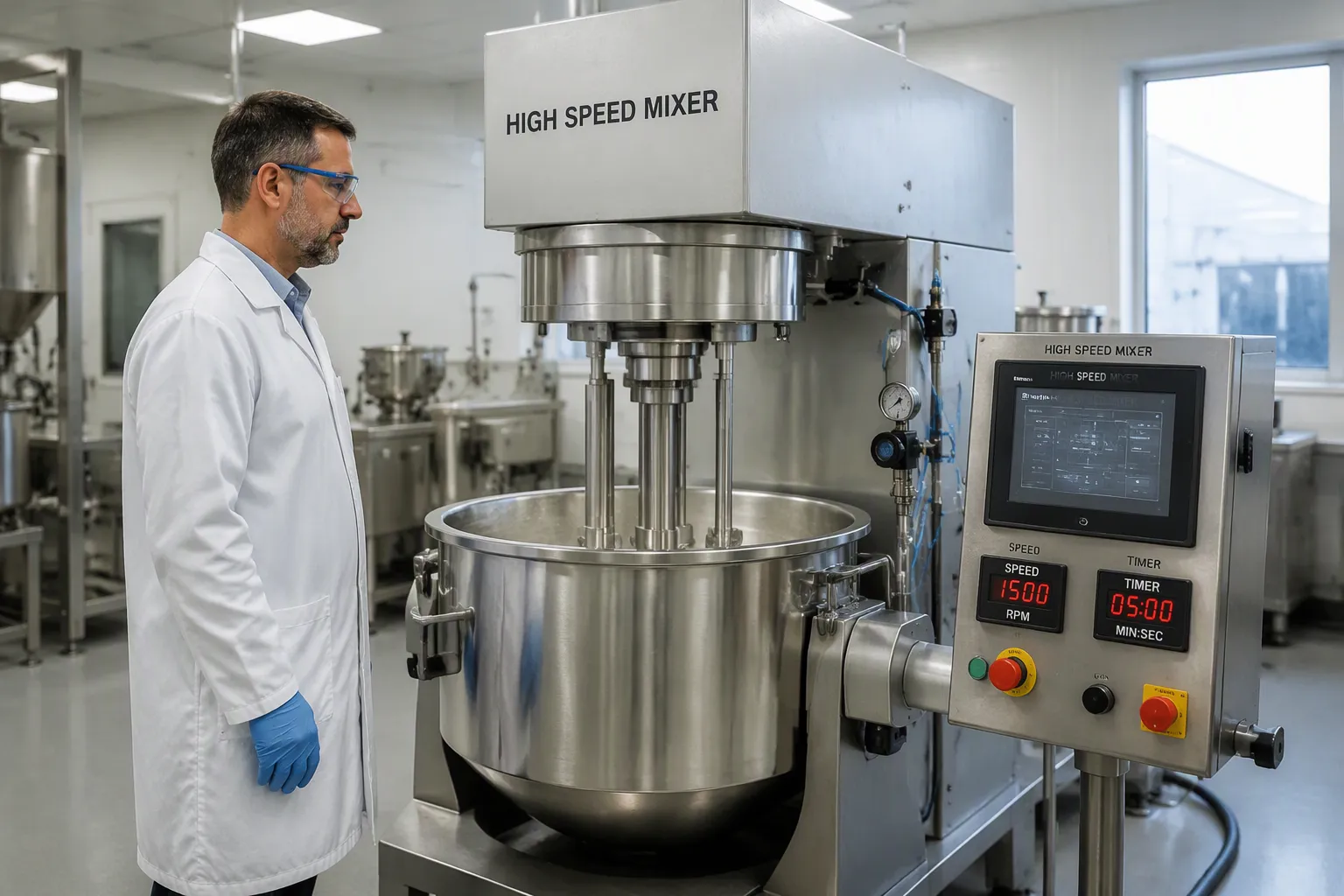
A high speed mixer is an industrial machine that uses a fast-spinning rotor or impeller to blend, disperse, and homogenize liquids, powders, and slurries. It does this in a fraction of the time a conventional agitator needs. The high rotational speed creates intense shear forces at the mixing head. These forces break down agglomerates and drive stubborn ingredients into a uniform blend. This article explains the working principle behind the equipment. It covers the rotor-stator and impeller components, the role of high shear, and the way tip speed shapes results. It also shows where this mixer fits among the many types of industrial mixing equipment, so readers can judge whether the option suits their process.
Key Takeaways
A high speed mixer uses a fast-spinning rotor and a fixed stator to mix liquids and powders quickly.
The space between the rotor and stator makes strong shear forces. These forces break up clumps and keep emulsions stable.
Tip speed measures how fast the edge of the impeller moves. It controls how strong the mixing is.
High speed mixers work well for emulsification, dispersion, and particle size reduction in many industries.
Pick the right impeller and tip speed for your material. This helps you get results that are consistent and high in quality.
Different Types of Mixers in Industrial Processing
Common Industrial Mixer Categories
Different types of mixers serve different process goals, and industrial mixing equipment covers a broad family of machines. Each industrial mixer design suits a particular material and a particular mixing task. Tumbler mixers rely on rotational motion and gravity to recirculate powders. Ribbon mixers use flat blades to move bulk solids through a continuous process. Paddle mixers feature angled paddles on a horizontal axis for dry and liquid-solid blending. Planetary, double arm, and dual- or triple-shaft designs handle pastes and other demanding formulations. Static mixers contain no moving parts and serve low-viscosity liquids in continuous flow. Powder and liquid mixers specialize in one phase or the other.
Engineers group these types of mixers in several ways. Industrial mixers also fall into batch and continuous categories. Batch mixers complete one fixed amount at a time, while continuous mixers receive a steady feed. Agitator mixers use a rotating impeller, static mixers use fixed baffles, and powder or liquid mixers target a specific phase. Diffusion, shearing, and convection form a second common grouping. This classification helps engineers match a machine to viscosity, density, and reactivity.
Where High Speed Mixers Fit
A high speed mixer, also called a high-speed disperser, occupies the shearing and convection corner of this landscape. The rotor turns fast and generates intense shear at the mixing head. This action suits emulsification, homogenization, dispersion, and particle size reduction. Vertical high-speed mixers and other high-speed mixers excel where ingredients resist blending, such as oil and water. High shear mixers serve cosmetics, pharmaceuticals, and fine chemical work. Standard batch mixers remain the better fit for simple, low-shear mixing and frequent formula changes.
No single design wins everywhere. A ribbon blender handles dry powder blending with less energy. A static mixer fits a steady, low-viscosity stream. The high speed mixer earns its place in demanding mixing duties and in applications that need a stable emulsion or a fine dispersion. Buyers who compare types of industrial mixers should weigh material behavior first, then batch size and throughput.
How a High Speed Mixer Works
Key Components: Rotor-Stator and Impeller
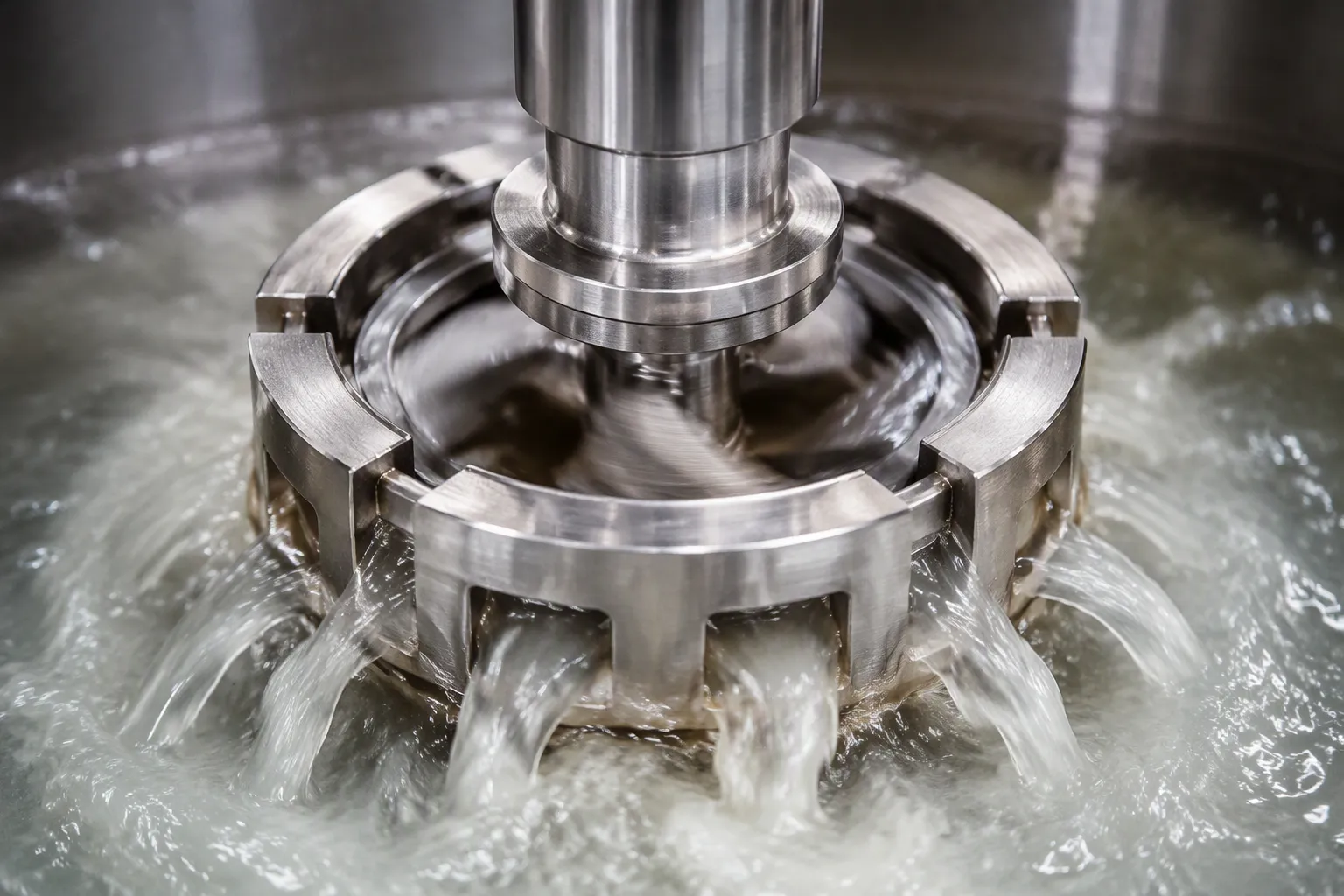
Every high speed mixer depends on a small set of parts. The rotor is the fast-spinning part, made as blades or an impeller. The stator is a fixed ring with slots or holes. Together they make up the workhead, which is also called the generator. This assembly pulls material in, pushes it through a narrow gap, and throws it back out using centrifugal force. The cycle repeats without stopping.
Shear happens when layers of fluid next to each other move at different speeds. A spinning rotor moves the fluid, and the rotor tip travels faster than the area near its center. That difference in speed creates the shearing action. A stator with a close clearance makes the effect stronger. Material leaves the rotor through a tight gap, and this creates a very high-shear zone. Large high-shear rotor-stator mixers may have several workheads in one unit.
Choosing the right impeller matters just as much. Blade count, blade angle, and impeller diameter all affect the shear forces a machine can produce. Batch size and viscosity then decide how much motor power the job needs. In high viscosity mixing, a small impeller spinning fast cannot pump enough material. Larger impellers running slower with higher torque move thick products the right way. Vertical high-speed mixers usually mount the head off-center in the vessel, at least one rotor diameter above the bottom.
Creating High Shear and Speed
A four-blade rotor inside a close-tolerance stator usually turns at tip speeds of 3,000 to 4,000 feet per minute. The tight stator limits flow, so these rotor-stator mixers give strong shear but only modest pumping capacity. When a recipe needs finer droplets or particles, ultra-high shear designs reach tip speeds up to 11,000 feet per minute.
High shear mixing solves a common problem: oil and water will not stay mixed. Conventional agitators just push the two phases around the tank, and the mixture separates once the blades stop. A high shear mixer forces the liquids through the shear zone over and over. Droplet size gets smaller, and the two phases form a stable emulsion. Smaller, more even droplets resist separation over time.
Stator style fine-tunes the result. Peak shear stays about the same across designs. What changes is the residence time in the mixing chamber.
Stator style | Shear | Turnover | Best use |
|---|---|---|---|
Slotted head | Good balance | Good balance | Most popular; general recipes |
Round hole | Similar peak shear | Highest | Disintegrating large solids |
Large square hole | Similar peak shear | Highest | Disintegrating large solids |
Fine screen head | Similar peak shear | Lower (longer residence) | Emulsions |
These principles apply across industrial mixing duties. High shear mixers work well for emulsions, dispersions, and particle size reduction. Standard batch mixers stay the simpler choice for routine blending. Matching the head to the product keeps high-shear applications efficient and repeatable.
The Mixing Process and Tip Speed
What Tip Speed Means
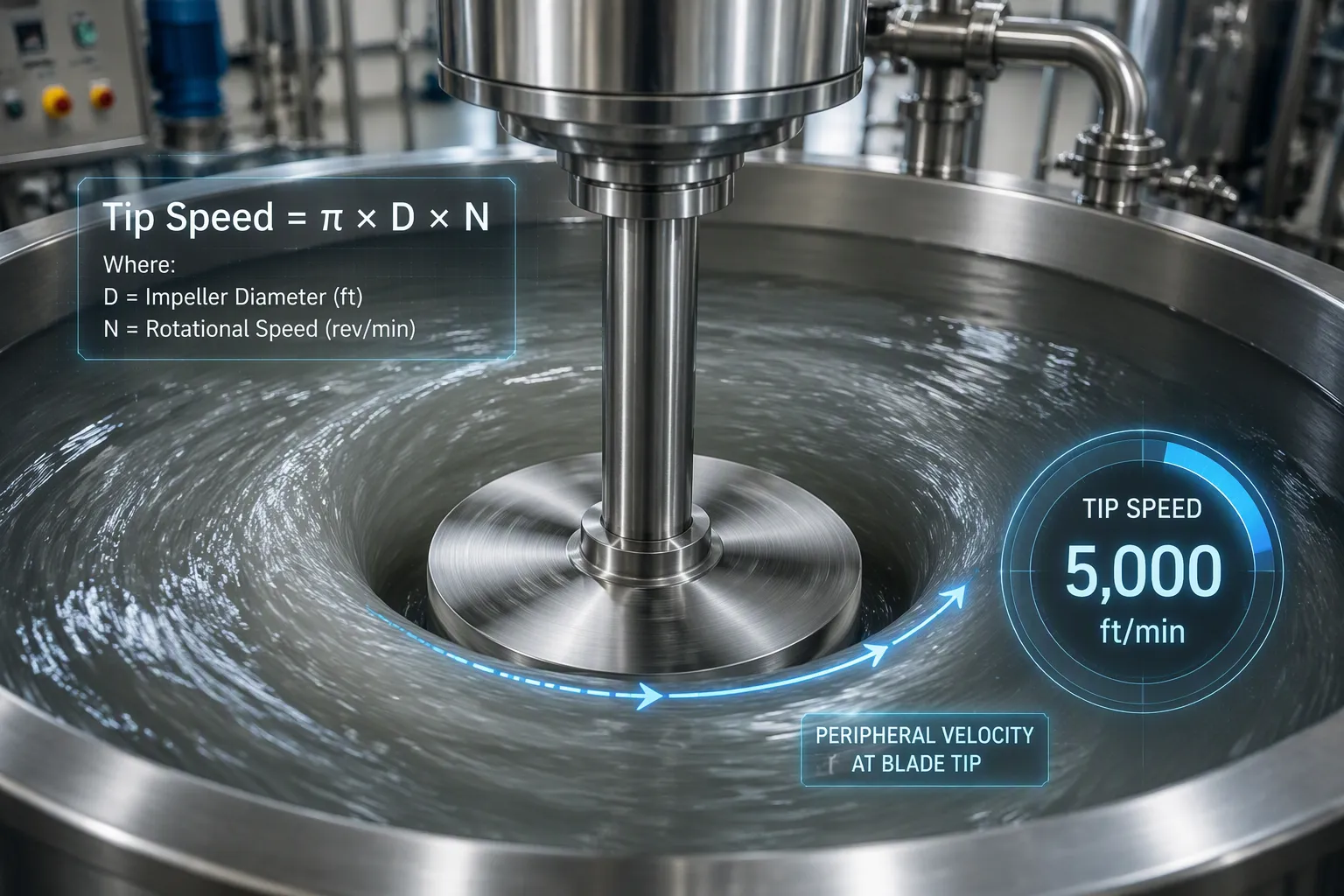
Tip speed is the straight-line speed of the outer edge of a spinning impeller. Engineers also call it peripheral velocity. The tip goes around the whole impeller circle with each turn. So a bigger impeller or a faster shaft moves the tip farther in the same time. The math is simple: tip speed equals pi times impeller diameter times shaft speed. A common shop formula for dispersion blades is FPM = RPM × 0.262 × blade diameter in inches. Tip speed is measured in feet per minute or meters per second.
Tip speed matters because it sets how strong the shear is at the workhead. Two machines can run at the same rpm and give very different shear if their impellers are different sizes. Tip speed puts both variables into one number. That lets operators compare mixing intensity across industrial machines and across scales.
How Tip Speed Affects Results
Tip speed drives dispersion, homogenization, and blend consistency. For dispersion blades, the usual operating window runs from 2,500 to 5,000 feet per minute. General mixing needs only 1,000 to 2,500 feet per minute. High shear emulsification calls for 3,000 to 5,000 feet per minute, and super high shear work starts at 6,000 feet per minute and above. Ultra-high shear mixers reach tip speeds up to 11,000 feet per minute. High-speed dispersers work best when the flow pattern is doughnut-shaped and blade tips travel at about 5,000 feet per minute in medium-viscosity media of 1,500 to 5,000 cP. Lower tip speeds may be fine at higher viscosities, and higher tip speeds at lower viscosities, to get the same shear rate and stress.
Higher tip speed raises shear, and shear breaks agglomerates and spreads solids out. This effect helps give uniform blending in many industrial recipes. Power rises with the cube of speed and the fifth power of diameter. So a small speed change can double or halve mixing intensity. Extra energy can also turn into heat, and frictional heat can harm temperature-sensitive compounds. Shear-sensitive formulations can turn too thin and lose texture. High viscosity mixing often runs better at low-to-moderate tip speed. There the impeller moves the batch efficiently without wasting power.
Scale-up follows the same logic. Constant tip speed is the usual rule for dispersion and shear-sensitive products. A larger impeller covers a longer distance in a shorter time, so engineers recalculate mixing time for the new size.
Quality checks close the loop. Fineness of grind on a Hegman gauge (ASTM D1210, 0–8 scale) shows whether pigment agglomerates have broken down. A minimum blade tip speed of about 2,500 feet per minute is commonly recommended for high shear dispersion, with a blade roughly one-third of the vessel diameter. Free-flowing, friable powders with a large particle-size differential need lower rotation speed to prevent segregation. Cohesive powders need mid-to-upper rotation speed to disrupt inter-particle forces. Over-mixing and under-mixing both degrade product quality. High shear mixers and high-speed mixers earn their place in these demanding duties, while batch mixers remain the simpler choice for routine blending. These applications reward careful tip speed selection, and the mixing process stays predictable when operators match speed to product.
Industrial Mixer Applications and Benefits
Typical High-Speed Mixer Applications
High-speed mixers are used in many kinds of industrial work. Every application depends on the same shear action, but the goal is different for each process.
Process | Description | Industries and applications |
|---|---|---|
Emulsification | Blends two liquids that do not mix into a stable emulsion | Pharmaceutical mixing of creams and gels; cosmetics; food sauces and dressings |
Particle size reduction | Makes particles smaller to improve performance | Chemicals; pigments; coatings |
Dispersion | Spreads substances into a mixture that is the same throughout | Paints; coatings; inks |
Homogenization | Creates a uniform mixture with even particles | Food sauces, creams, and dairy items |
Deagglomeration | Breaks up clumped particles so they spread evenly | Fertilizers |
Wet milling | Grinds solids in liquid as a pre-mix step | Pharmaceuticals |
Adhesives and batteries also rely on this equipment. High-speed mixers spread powders into liquid carriers for electrode pastes and slurries. This step improves flow properties and electrochemical performance. In food production, high shear mixers build stable emulsions and make particles smaller for better mouthfeel. The same blending and mixing action helps keep flavor and texture consistent.
Performance Benefits and Selection Fit
The applications and benefits of mixers come down to output quality. High-speed mixers give homogeneous blends and consistent quality from batch to batch. They cut processing time, and one machine often does the work of several steps. Food producers save money when mixing finishes faster.
Changhai Drying Equipment offers industrial mixing equipment made for blending powders, granules, and slurries. The line fits chemical, pharmaceutical, food and agricultural, and new materials processing. Buyers should think about material type first. High viscosity mixing needs slow, high-torque designs, while dispersion blades run at about 2,000 to 5,000 ft/min. Density matters too, because dense solids can settle and split a batch. Finally, batch mixers fit fixed volumes, and continuous units fit steady flow. Matching these factors keeps industrial mixing predictable.
A high speed mixer is an industrial machine that blends, disperses, and homogenizes bulk materials using a fast-spinning agitator. Its workhead pairs a spinning rotor with a fixed stator. The rotor pushes fluid through a tight gap, and the shear this creates breaks down agglomerates and keeps emulsions together. Tip speed sets how strong that shear is, so operators adjust it for each recipe. High-speed mixers are used in coatings, pharmaceuticals, cosmetics, food, and chemical processing. They give uniform blends, consistent quality, and faster throughput. Matching the head and the speed to the product keeps results predictable. The takeaway is simple: speed plus shear equals reliable, repeatable mixing.
FAQ
What makes a high speed mixer different from a standard agitator?
A standard agitator just moves a batch around the tank. A high speed mixer pushes material through a tight rotor-stator gap instead. That gap creates intense shear. The shear breaks down agglomerates and holds emulsions together. You can see the difference in mixing time and in how even the blend turns out.
Which materials suit high shear mixing best?
High shear mixing fits emulsions, dispersions, and particle size reduction. Oil and water resist blending under a simple paddle. A rotor-stator head forces the phases through the shear zone again and again. Droplets shrink, and the emulsion stays stable.
How does an operator choose the right tip speed?
The recipe sets the target. Dispersion blades usually run at 2,500 to 5,000 feet per minute. General blending needs less. High shear emulsification calls for 3,000 to 5,000 feet per minute. Shear-sensitive products and thick pastes often run better at lower tip speed. Operators check fineness of grind to confirm the result.
Can one machine replace several processing steps?
Often, yes. A single high speed mixer can disperse, homogenize, and reduce particle size in one vessel. That cuts handling between steps and shortens the mixing cycle. Batch mixers still fit simple blending jobs. The right choice depends on the material and the batch size.
What should a buyer check before selecting an industrial mixer?
Material type comes first. Viscosity and density decide the impeller size and motor power. Batch versus continuous operation shapes the vessel design. These applications reward careful matching. A buyer who weighs all three factors gets predictable mixing and consistent quality.