




What Are the Different Types of Pharmaceutical Powder Mixers?
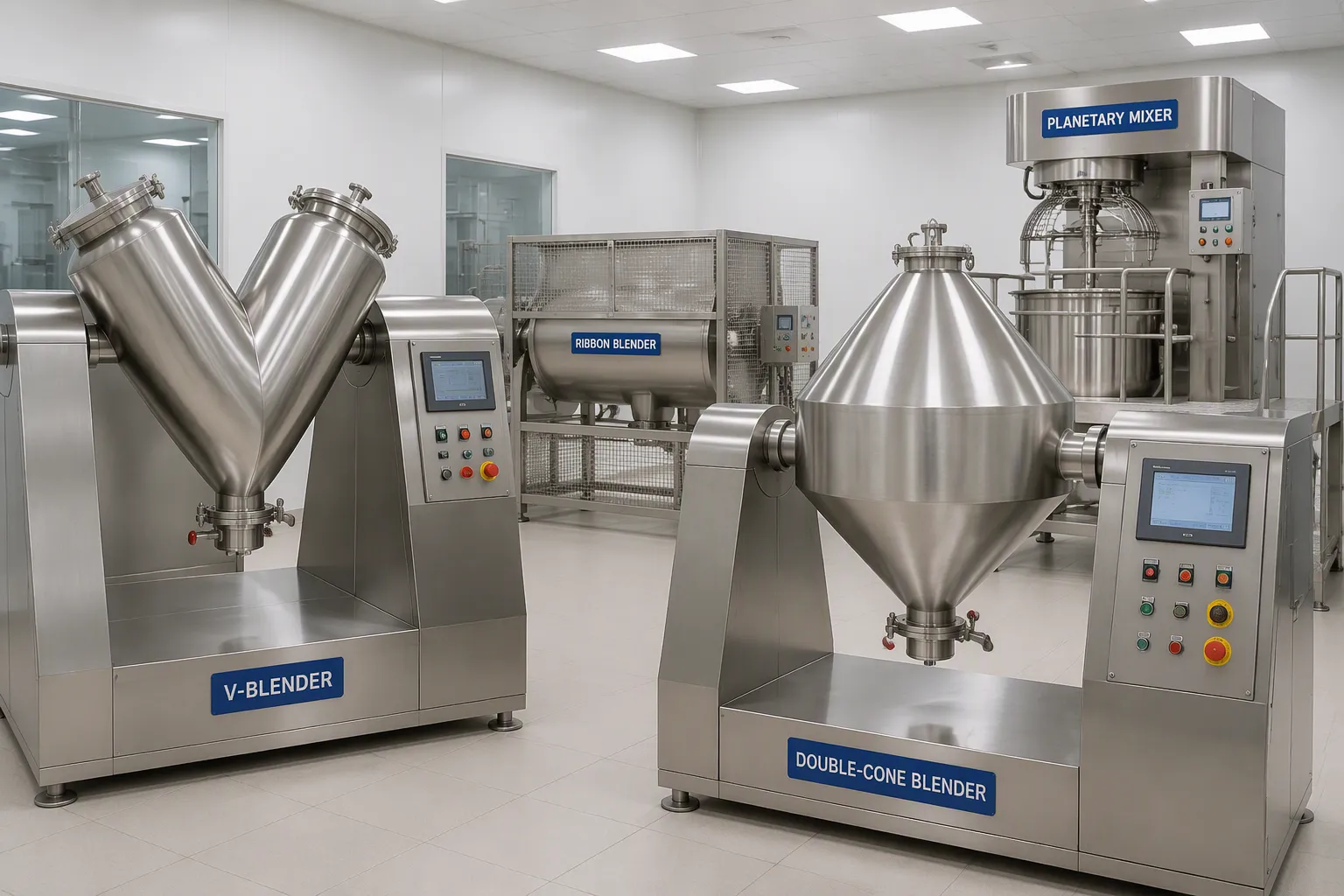
Common types of pharmaceutical powder mixers include ribbon blenders, V-blenders, double cone blenders, planetary mixers, high-shear mixers, fluid bed granulators, and tumbler-style blenders. Each pharmaceutical powder mixer has a different job when it comes to blending powders, granules, and wet masses.
These mixers work in different ways: convective, diffusive, and shear action. That one difference explains why there are so many kinds of powder mixers. A buyer who understands how each powder mixer works can match pharmaceutical mixers to a formulation with confidence. Ribbon blenders and v-blenders show this range well.
Key Takeaways
Pharmaceutical powder mixers use three main ways to mix: convective, diffusive, and shear.
Ribbon blenders and V-blenders are common mixers for dry powders and granules.
High-shear mixers make strong granules for tablets and capsules.
Fluid bed granulators mix, granulate, and dry powder all in one machine.
Pick a mixer based on how the powder flows, the batch size, cleaning needs, and rules you must follow.
How Pharmaceutical Powder Mixers Work
Convective, Diffusive, and Shear Mixing
Every pharmaceutical powder mixer uses one or more of three mixing mechanisms. Each mechanism moves material at a different scale and speed.
Mechanism | Definition | Scale of mixing | Mixing rate |
|---|---|---|---|
Convective | Moves a large group of particles from one place to another; system geometry such as paddles and baffles controls the flow | Macroscopic | Fairly high, but uniformity still takes a long time because particles inside the moving group do not mix well |
Shear | Moves one layer of particles against another layer through speed differences or compression of the powder bed | Semi-microscopic | Medium |
Diffusive | Moves single particles through random motion as empty spaces open in the expanded bed | Microscopic | Fairly low |
Convective mixing, also called macro-mixing, does the bulk transport work. Shear mixing handles the sliding between layers. Diffusive mixing, or micro-mixing, finishes the job at the particle level. These three mechanisms set apart the many types of mixers on the market. Ribbon blenders depend on convection, V-blenders on diffusion, and high-shear units on shear. Students who learn this pattern can predict how most powder mixers will act.
Batch Versus Continuous Operation
Most pharmaceutical solid powder mixing runs as a batch process. A batch keeps one formulation together, so the operator can test content uniformity and release the lot with confidence. Batch records also make traceability simpler for regulators. Batch operation fits dry-powder blending of cohesive or low-dose formulas, where one error costs a lot.
Continuous operation offers real benefits. Throughput goes up, changeovers get faster, and closed systems improve containment. Small continuous blenders also lower segregation risk because residence times stay short. The drawbacks are just as real. Upfront capital is significant, process development requires extensive validation, and feeding ups and downs can disturb content uniformity for low-dose drugs. These challenges explain why continuous lines are still less common in pharmaceutical mixing, though adoption is growing. A dry powder mixer on a continuous line needs careful feeder design. Many pharmaceutical mixers still run in batch mode for this reason. Dry-powder mixers in development labs often bridge both worlds. No single powder mixer suits every formulation.
Tumble and Convective Blenders
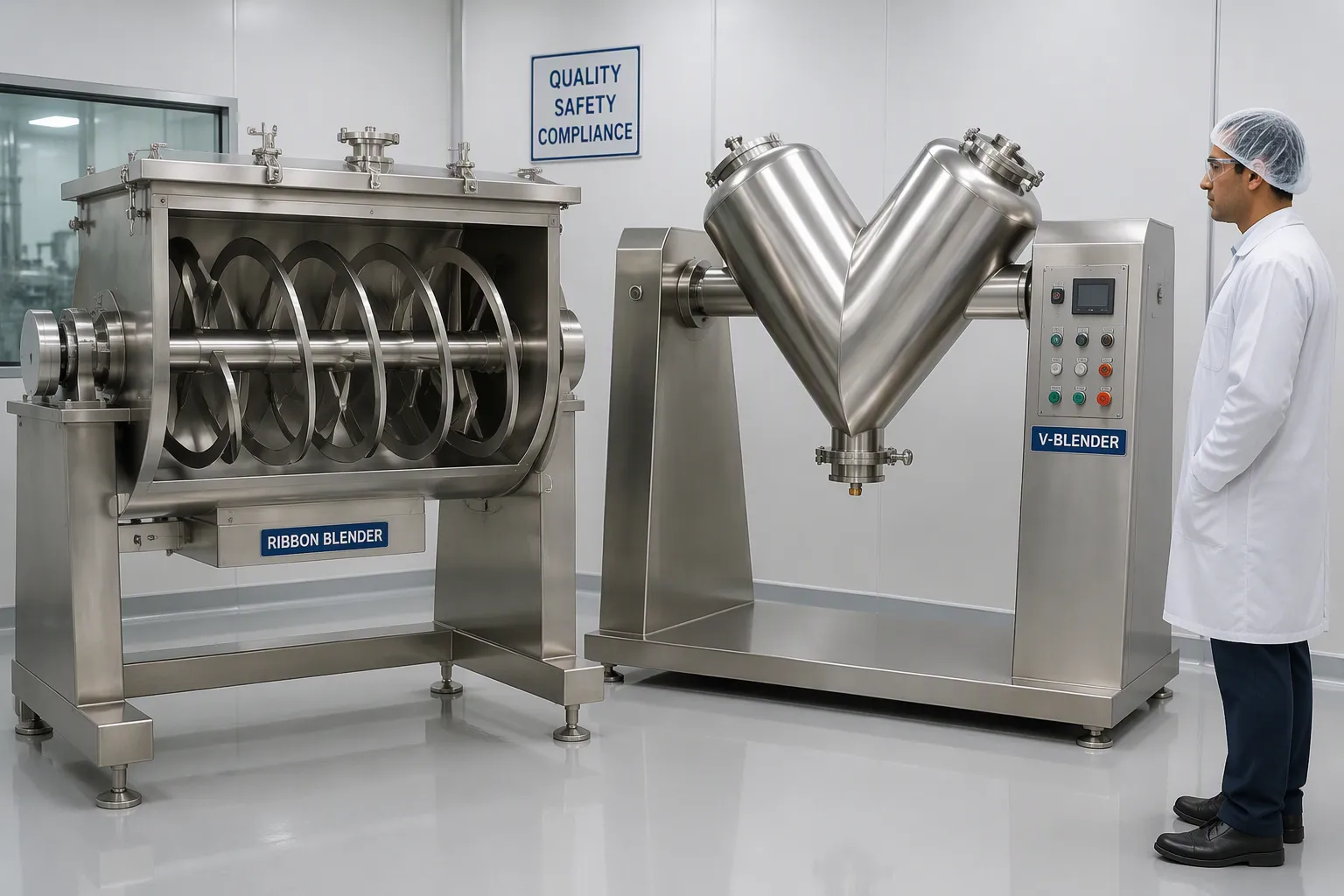
This family covers two main groups: convective units that push powder with moving parts, and tumble units that spin the whole vessel. Both groups show up among the different types of blenders in pharma, and each one fits a different powder behavior.
Ribbon Blenders
A ribbon blender uses a flat U-shaped trough and a central shaft. Two spiral ribbons sit on that shaft. The outer ribbon pulls product from the sides toward the middle. The inner ribbon pushes product back out. This folding motion makes a convective pattern, and cycle times run from a few minutes up to about 20 minutes. Tip speed usually stays below 300 ft/min, so the gentle motion protects fragile particles.
Ribbon blenders handle powder premixing before granulation. These ribbon blenders blend dry ingredients ahead of the granulation step. Plants also use ribbon mixers for granules, pastes, and slurries. These ribbon mixers are versatile and save money. Stainless steel 316 or 316L wetted surfaces, polished to 150-grit or higher, resist buildup and make cleaning easier.
Limitations exist. Fine or sticky powders may separate. High bulk density materials can mix unevenly. Large units use more energy. Overmixing can harm sensitive actives. A variable frequency drive supports soft starting and overload protection. Among the types of mixers available, ribbon blenders remain a common choice for high-volume dry blending. Many plants pair ribbon blenders with downstream drying. A ribbon blender handles large batches well. Ribbon blenders also accept heating or cooling jackets. A ribbon blender with a vacuum lid suits containment needs. These ribbon blenders and ribbon mixers share the same convective principle.
V-Blenders and Double Cone Blenders
A v type blender uses a single V-shaped vessel. The V shape creates a natural flow pattern as the shell turns. Each turn produces new particle-to-particle contacts, and enough turns yield a statistically homogeneous blend. A v-type mixer handles powders, granules, and abrasive substances. These v-blenders blend fast with minimal separation. Larger capacities suit high-volume operations. These v-blenders also clean easily. Many v-blenders accept intensifier bars. Operators favor v-blenders for fast cycles. These v-blenders lower cross-contamination risk.
The double cone pharmaceutical blender uses two opposing cones joined at the center. A double cone blender produces a gentler, lower-shear action than a v type blender. Diffusive mixing dominates, and light shear breaks soft agglomerates. This double cone mixer fits free-flowing, non-cohesive powders. These double-cone blenders protect fragile and heat-sensitive materials. These double-cone mixers are easy to clean and maintain. These double-cone blenders also handle granules. These double-cone mixers suit heat-sensitive products. Poorly flowing powders can form dead zones if overfilled.
Related tumbler-style options include tumbler mixers, octagonal blenders, square cone mixer designs, and the three-dimensional motion mixer. A three dimensional motion mixer combines rotation and translation for complex paths. The three-dimensional motion mixer suits gentle blending of delicate products. A three dimensional motion mixer also reduces separation. The three-dimensional motion mixer works well for small batches. A three dimensional motion mixer offers another path within this family. The three-dimensional motion mixer and the square cone mixer both rely on vessel motion. A three dimensional motion mixer needs free space for cascading. These tumbling blenders share the same diffusive principle. These tumbling blenders differ mainly in vessel geometry. A powder mixer of this kind needs careful sizing. Among pharmaceutical blenders, tumble designs remain popular for dry powders. The types of blenders and mixers in this group overlap in function.
High-Shear and Planetary Mixers
High-Shear Mixers
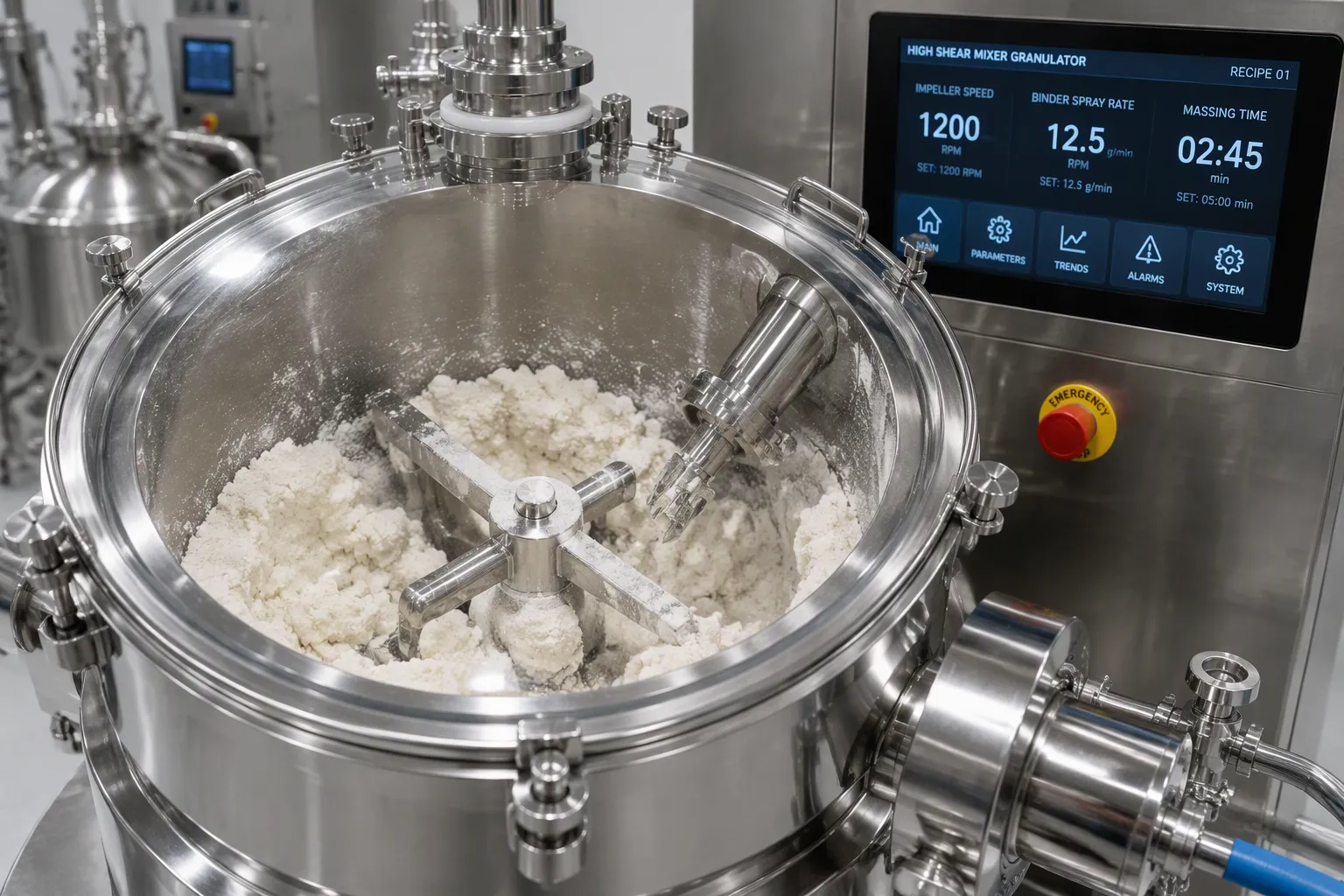
A high-shear mixer has a round bowl, a four-arm impeller, and a chopper. The impeller spreads the granulating fluid and makes strong shear between particles. The chopper breaks up wet lumps as granules form. Working together, they turn sticky powders into medium- to high-density granules that flow and press well. That is why high-shear units are a key part of pharmaceutical mixing for tablets, capsules, sachets, nutraceuticals, and biotech products.
Process control matters more here than in most types of mixers. Impeller speed, binder spray rate, and massing time all shape granule size, density, and dissolution behavior. If the impeller speed is too low, the granules come out weak with unwanted porosity. A longer massing time adds shear, growth, and densification. The chopper speed has a strong effect on granule size and distribution. Operators set these variables for each formulation and watch them closely.
Parameter | Role |
|---|---|
Binder spray rate and amount | Affects porosity and granule size; more liquid forms rounder granules through liquid bridges |
Impeller speed | Creates shear between particles; too little speed limits granule growth |
Massing time | Longer time increases shear, growth, and densification |
Drying temperature and time | Affects intermediate and finished product quality |
High intensity brings heat. Mechanical energy turns into heat inside the vessel, and product temperatures can climb by about 10 to 30 °C without cooling. Materials that break down below about 40 °C may need low-shear alternatives or jacketed equipment with active temperature control. Cleaning also needs attention. Sanitary, crevice-free designs with electropolished surfaces and CIP/SIP capability make automated cleaning and sterilization simpler. Multi-product facilities must prove residue removal stays below acceptance limits, so accessible surfaces and self-draining layouts help.
Planetary and Conical Paddle Mixers
A planetary mixer uses two or three multi-hinged blades. The blades go around the central axis and also spin on their own axes at the same time. This planetary motion pushes material up, down, and around the inner cylinder, so a thorough blend forms in a short time. A scraper keeps sweeping the bowl wall and brings stuck material back to the mixing zone. The design suits pastes, high-viscosity masses, and high-density materials, and it handles gentle blending of sensitive formulas at low to medium shear.
Conical paddle mixers, often called Nauta-style units, follow a similar gentle approach. A screw or paddle circles the cone wall and lifts material from the bottom to the top. The powder bed turns over slowly, so segregation stays low and fragile particles survive intact. These units fit uniform blends of free-flowing and moderately cohesive powders.
Each option has trade-offs. High-shear mixers give fast, dense granules but make heat and demand rigorous cleaning validation. Planetary and conical paddle units protect sensitive ingredients but take longer and suit smaller batches. A powder mixer choice should follow the formulation, not a ranking. For pharmaceutical mixers, the right fit depends on the process goal.
Fluid Bed Granulators and Other Types of Mixers
Fluid Bed Granulators
A fluid bed granulator puts powder in a chamber and blows heated air up through the bed. The air makes the particles float, so they act like a boiling liquid. Then a nozzle sprays binder solution onto the moving powder. Granules form as particles bump into each other and stick. The same chamber then dries the granules with heated air. This one-pot design does mixing, granulation, and drying in a single unit. That saves lab space and lowers investment and maintenance costs.
Nozzle position changes how the granules turn out. Top spray units put nozzles at the top and spray down onto the floating powder. Bottom spray units spray upward into a fountain of particles. Tangential spray units angle nozzles at the middle section. Each version has trade-offs in granule shape, over-wetting risk, and scale-up potential. Poor parameter settings can push the process toward spray-drying instead of agglomeration.
Fluid bed granulators serve tablet, capsule, and sustained-release granule production across pharmaceutical, chemical, and food industries. Limitations exist. Fines carryover can lower yield, and sticky or low-melting materials may stick to walls. A stepped airflow profile and anti-tacking agents such as magnesium stearate can help. Scale-up also demands re-optimizing bed height, air velocity, and drying time.
Fluidized Zone and Vertical Blenders
A fluidized zone mixer uses a horizontal cylindrical vessel with counter-rotating paddle shafts. The blades toss particles into a weightless state, so delicate or heat-sensitive materials blend without damage. Pharmaceutical plants often use these units for coating and granulating. A single-shaft version works well for wet materials and stops wall buildup.
Vertical blenders offer another option among the pharmaceutical types of mixers. A vertical ribbon mixer handles solids, powders, and pastes with high precision, even at extreme ratios. A conical screw mixer uses one or two asymmetric screws that spin on their own axis while circling the cone wall. These designs suit batches where density, particle size, and proportion vary widely. Each powder mixer in this group fits a different blending challenge, and no single types of mixers covers every formulation. Buyers who compare these types of mixers against their material behavior will shortlist more effectively.
Selecting a Pharmaceutical Powder Mixer
Capacity, Efficiency, and Cleaning
A good choice starts with the formulation. Particle size, bulk density, flowability, and moisture sensitivity all affect how a powder acts in the vessel. Cohesive or low-dose blends need more active movement, while fragile granules need gentle handling. The batch size then sets the vessel volume, and bulk density sets the motor power. Nominal volume is never the same as usable capacity, because powder needs room to move. Most designs work best when the fill level stays in a set range, often about 40% to 70% of vessel volume. Overfilling limits movement and creates dead zones.
Mixing efficiency depends on speed, time, and the order you add ingredients. Fast rotation improves dispersion but can raise dust, heat, or segregation. A blend uniformity target of 5% CV or below is a common practical benchmark, though limits vary by product. Material trials should cover loading sequence, representative multipoint sampling, discharge behavior, and residue inspection.
Cleaning deserves equal weight. Smooth, sloped stainless surfaces with rounded corners and quick-release parts reduce residue. Validation follows a clear path: identify worst-case products, set residue limits, write the cleaning SOP, and combine swab with rinse sampling. FDA guidance states that rinses alone are not acceptable as the only verification method.
Compliance and Scale-Up
GMP compliance rests on documented validation. Installation, operational, and performance qualification confirm that the equipment works as designed and produces consistent batches. Process records should capture load weight, moisture, speed, mixing time, and sampling locations. Traceable data logging supports audits and trend analysis.
Scale-up brings its own challenges. Geometry, fill level, and blending time must stay aligned across scales. One common approach keeps total vessel revolutions constant, so a larger unit runs longer rather than faster. The Froude number helps preserve dynamic similarity, and rotational speed typically drops as radius grows. A Quality-by-Design approach, aligned with ICH Q8, reduces variability during technology transfer.
Suppliers can support this work. Changhai Drying Equipment offers mixing equipment alongside drying systems and provides testing and FAT before shipment, which helps buyers confirm performance before installation.
Each type of pharmaceutical powder mixer does a certain job. Tumbling units like V-blenders and double cone blenders work well for free-flowing powders and gentle blends. High-shear mixers are used for wet granulation and sticky formulas. Fluid bed granulators mix, granulate, and dry in one vessel.
A short checklist can help readers pick from the many types of mixers. First, look at the formulation and how it flows. Next, check the batch size and the scale-up path. Then think about cleaning needs and containment. Last, check compliance and data logging. No single design is best at everything, so match the equipment to the process.
FAQ
Which mixer works best for free-flowing powders?
Tumble designs like V-blenders and double cone blenders work well for free-flowing, non-cohesive powders. The turning vessel creates diffusive mixing with low shear. Overfilling can cause dead zones and uneven blends.
When should a formulator choose a high-shear mixer?
A formulator chooses high-shear mixing for wet granulation and cohesive blends. The impeller and chopper turn sticky powders into dense, flowable granules. Mechanical energy adds heat, so product temperatures can rise by about 10 to 30 °C without cooling. Heat-sensitive materials may need a gentler option.
Can one machine mix, granulate, and dry?
Yes. A fluid bed granulator floats powder on heated air, sprays binder, and dries the granules in the same chamber. This one-pot design saves lab space and lowers investment and maintenance costs. Sticky or low-melting materials may stick to walls, so parameter tuning matters.
How does a buyer shortlist the right equipment?
Start with how the formulation behaves, then batch size and the scale-up path. Next, weigh cleaning validation and containment needs. Finally, confirm GMP documentation and data logging. Each of the many types of mixers fits a different process goal, so no single pharmaceutical powder mixer wins on every count.