




How to Select a High Speed Mixer for Powder Processing
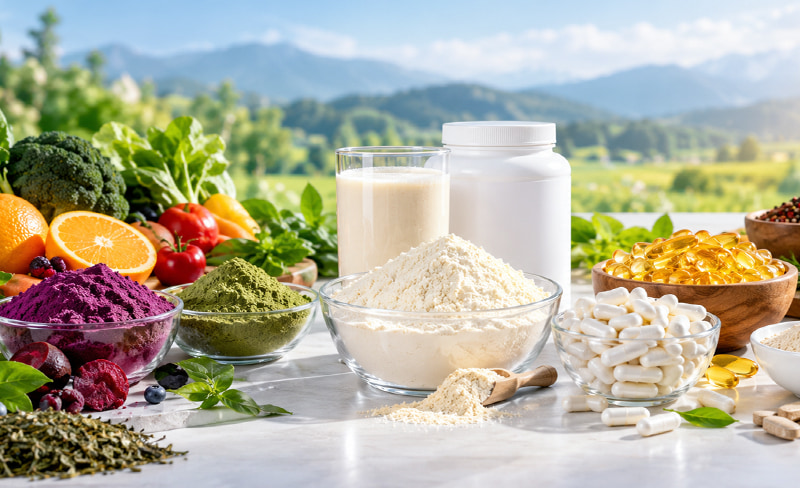
Pick a high speed mixer for powder mixing based on two numbers: the hourly output you need and the bulk density of your material. Mixer volume by itself tells you very little. If you size by volume, you may buy a machine that is too big, which wastes money and energy on a mixer you never fill. If it is too small, you miss output targets and mix quality drops. This guide gives you a step-by-step method for powder processing. You will learn to figure out real capacity, go from cycle time to batch size, compare types of industrial powder mixers, and fix common bottlenecks before they cut your throughput.
Key Takeaways
Pick your mixer based on two key numbers: hourly output and bulk density. Volume by itself can lead you the wrong way.
Figure out the real cycle time by adding up the loading, mixing, and discharge times. The slowest step decides your true hourly output.
Change your batch size into mixer volume by using bulk density. Keep the fill level between 40% and 70% to get the best results.
Pick the mixer type that fits how your powder flows and what quality you need. High shear mixers break up clumps; ribbon mixers work well for powders that flow freely.
Fix problems like underfilling, slow discharge, and heat buildup to keep your mixer productive. Automation and air-assisted hoppers help.
Start Mixer Selection With Output and Bulk Density
Why Volume-Only Sizing Fails
A mixer's volume tells you how much space the vessel holds. It does not tell you how much powder the machine can process in an hour. That gap between space and throughput sits at the heart of industrial powder mixer selection. You need two anchors: the output you must hit and the bulk density of your material.
Volume-only sizing fails in both directions. Buy a vessel larger than your real batch needs, and you tie up capital in a machine you never fill. The motor runs below its efficient load, and energy costs climb for no gain. Buy too small, and you miss your capacity and output targets. Mix quality also suffers, because a short cycle leaves the blend uneven.
How Bulk Density Changes Real Capacity
Bulk density is the mass of powder that fills a given volume. Two powders can share the same vessel and still demand very different machines. Consider common dry powders. Granulated sugar sits at 53 lb/ft³, powdered sugar at 35 lb/ft³, and salt at 70–80 lb/ft³. The same scoop holds far more salt than powdered sugar.
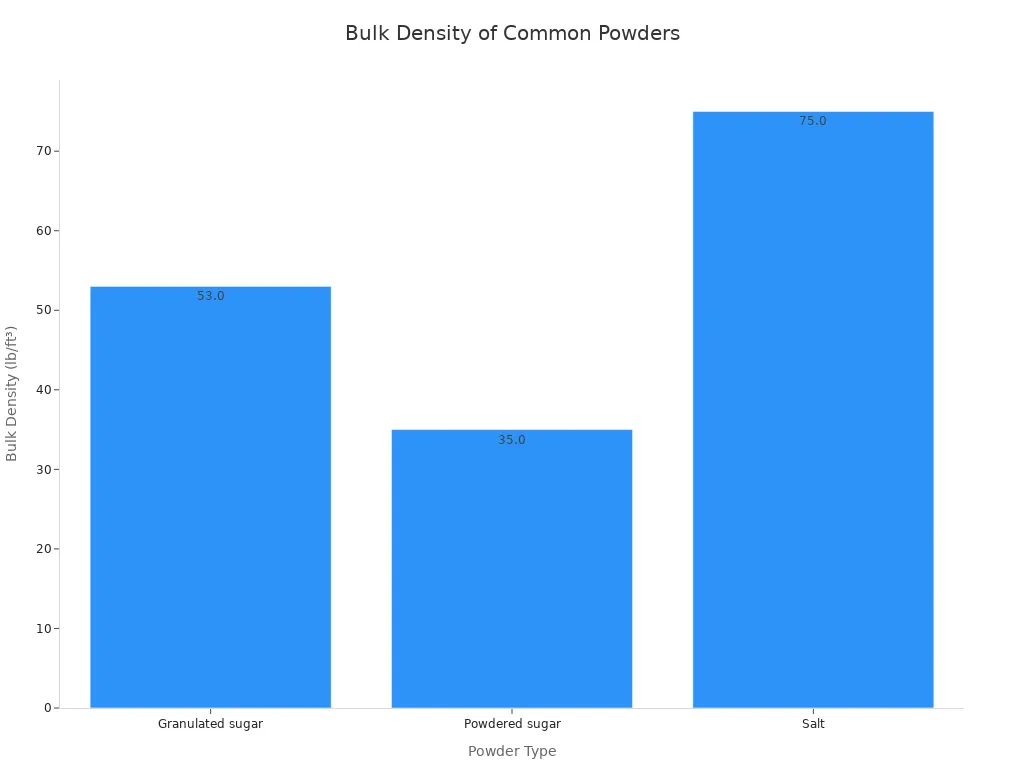
The table below shows how density shifts the load inside one working volume.
Parameter | Low-density powder | High-density powder |
|---|---|---|
Working volume | 1,200 L | 1,200 L |
Bulk density | 0.45 kg/L | 0.9 kg/L |
Batch mass | 540 kg | 1,080 kg |
Both vessels hold 1,200 L. The dense powder doubles the batch mass. Motor load, gearbox torque, shaft design, mixing time, and discharge time all feel that change. A 1,000 L mixer holds about 400 kg of 0.4 kg/L powder and about 1,000 kg of 1.0 kg/L material. Same volume, different torque and gearbox load.
This is why capacity vs output efficiency depends on mass, not liters. Test your powder's bulk density before you compare any industrial powder mixer. That single number drives production capacity, and it protects your mixer selection from a costly guess.
Mixer Capacity and Cycle Time for Powder Mixing
Good high shear mixing depends on two things: how strong the shear zone is and how well the process moves all the product through that zone. A strong rotor only blends the powder that reaches it. Powder sitting in a dead corner never gets that shear. Fill level matters too, because an overfilled vessel leaves the top layer outside the active zone. This is why cycle time, not volume alone, defines throughput. A high speed mixer for powder mixing earns its rating by moving every particle through the shear zone in a short, repeatable time.
Calculating Real Cycle Time
Rotor and chopper speeds set the shear intensity. The table below shows typical ranges for this equipment.
Parameter | Speed Range (RPM) |
|---|---|
Mixing/impeller rotation speed | 15–280 |
Cutting/chopper rotation speed | 300–2900 |
Impeller speed during binder addition | 5–300 |
Chopper speed during wetting/granulation | 200–3000 |
A fast chopper creates strong local shear at the particle level. A slow main impeller moves the bulk batch past that zone. You need both working together. A fast chopper with poor bulk movement blends one pocket well and leaves the rest untouched. The impeller speed during binder addition runs lower on purpose, so the batch absorbs liquid without smearing.
Real cycle time covers more than the mixing phase. Add loading, dry blending, binder addition, wetting, discharge, and cleaning. Measure each step on your own line. Then divide your hourly target by the number of batches you complete in that hour. That figure gives you the true mixer capacity you can plan around. A short mix phase inside a long load-and-discharge cycle still caps your hourly output. Track discharge time separately, because a slow valve or a sticky powder can add minutes to every batch.
How Powder Flow Affects Mixing Performance
Material properties shape how fast you reach a homogeneous blend. Particle size, flowability, and bulk density all matter. Free-flowing powders spread through the vessel quickly. Cohesive powders clump and need more mechanical work. Smaller excipient particles reached content uniformity faster than larger ones in blending trials. In one study, the relative standard deviation of the drug fell from about 15% at the start to roughly 1% after 32 minutes. The standard deviation began to plateau after approximately five minutes, when diffusional micro-blending became the dominant mechanism. Extra time past that point yields diminishing returns.
Particle size ratio drives segregation risk. A ratio below 2:1 blends excellently. A ratio of 2:1 to 5:1 gives the most stable and uniform blend. Ratios of 5:1 to 10:1 stay acceptable with optimized parameters. Ratios of 10:1 to 20:1 carry high segregation risk and may need granulation or coating. Above 20:1, mixing time alone cannot solve the problem.
Evaluate any industrial powder mixer on multiple mixing zones and consistent blend consistency. A single shear zone limits uniform mixing of dry powders with a wide size spread. Check powder mixer capacity against your real bulk density, not the nameplate working volume. That step protects your batch size and your output efficiency. A well-matched industrial powder mixer turns your powder data into a predictable cycle. A high speed mixer for powder mixing then delivers steady throughput, batch after batch. Ask any industrial powder mixer supplier for a trial run on your own powder before you commit.
A Step-by-Step Industrial Powder Mixer Selection Strategy
Industrial powder mixer selection follows a fixed chain of four steps. Each step feeds the next one, and skipping any link produces a guess instead of a decision.
Define your hourly output target. Turn the shift requirement into a rate. A plant that needs 5000 kg over a 6-hr shift needs about 833 kg/hr.
Calculate real cycle time. Count loading (5–10 min), mixing (8–15 min), and discharge (5–20 min). Discharge is often the bottleneck.
Calculate the required batch size. Divide the hourly target by the batches you can finish per hour. A 30-min cycle gives batches of about 416 kg.
Convert batch mass to mixer volume. Divide the batch mass by bulk density, then use the working-volume limit to pick the actual vessel.
From Output Target to Batch Size
Start with the production capacity your line must deliver. Then measure the full cycle on your own equipment. The slowest operation sets your real hourly output, whether that is loading, mixing, or discharge. This bottleneck rule keeps your output calculation honest.
Now divide the hourly target by the batches per hour. That result is your batch size. A 30-min cycle gives two batches per hour, so an 833 kg/hr target needs batches near 416 kg. Your powder mixer output then depends on how reliably you hit that cycle, batch after batch.
Converting Batch Size to Mixer Volume
The conversion rests on one relation: batch size in kg equals volume in liters times bulk density in kg/L. Rearranged, volume in liters equals batch size in kg divided by bulk density in kg/L. A 416 kg batch at 0.5 kg/L needs about 832 L of occupied space.
Do not stop there. Work within the best working volume range of 40–70% of the vessel. Overfilling causes poor mixing, and underfilling below 30% creates dead zones and segregation. Divide 832 L by roughly 0.7, and you land near a 1200-L mixer. The table below shows how batch mass and vessel size track together.
Batch mass (kg) | Bulk density (kg/L) | Occupied volume (L) | Mixer size at ~70% fill (L) |
|---|---|---|---|
160 | 0.4 | 400 | ~570 |
416 | 0.5 | 832 | ~1200 |
540 | 0.45 | 1200 | ~1700 |
A large capacity industrial powder mixer only earns that label when its motor and gearbox handle the heaviest powder in your SKU range. Size for the maximum bulk density, because a unit built for light flour fails with heavy minerals. Battery-grade lithium carbonate shows the spread: general spec runs 0.25–0.45 g/cm³, while high-density grades for solid-state precursors reach 0.40–0.55 g/cm³. That difference reshapes your batch size and your production capacity at the same vessel volume.
Validate every assumption with bulk density testing before you sign a purchase order. Test each SKU, not just the flagship product. Confirm discharge performance on a trial run as well. Sound mixer selection protects your output efficiency, and it turns nameplate capacity into capacity you can actually schedule.
Comparing Industrial Powder Mixer Types and Value
Performance and Application Fit
Match the mixer type to your material and your quality goal. A horizontal ribbon mixer works well for free-flowing dry powders like flour, detergent, or powdered chemicals. Its gentle motion keeps particles intact, and it blends using less energy. But it has trouble with sticky materials and with powders that have a wide range of particle sizes. Tumble mixers use rotation and gravity, with no impellers, and come in octagonal, cone, and V shapes. High shear units are great at dispersion, emulsification, and breaking down particles. Vertical high-speed designs reach tip speeds of 28–40 m/s and fluidize the bed, which separates small agglomerates well. A horizontal ribbon mixer runs near 1.4 m/s and cannot fluidize or break agglomerates. Faster tip speeds shorten cycle times, and past a certain point the powder acts like a liquid.
Vacuum mixers work below atmospheric pressure to remove voids, improve degassing, and dry sensitive ingredients at lower temperatures. Your choice depends on mixing speed, vacuum level, batch volume, particle size, and heating or cooling needs. A high speed mixer for powder mixing is the right pick when dispersion matters most. A bulk powder mixing machine built around gentle turnover fits fragile blends. Check material properties first: bulk density, flowability, shear sensitivity, and particle-size variation decide how your powder moves and whether it separates.
Compliance, Cleanliness, and Cost
Stainless steel construction made for hygiene reduces bacterial buildup and allows thorough cleaning, which helps prevent cross-contamination under 21 CFR Part 210. Automation and real-time monitoring keep batch quality consistent. Look for clean-in-place features, sealed designs, and welded agitators. Make sure the working volume and discharge method fit your plant workflow. A horizontal ribbon mixer has a simple design that is easy to clean and maintain, and that simplicity lowers upkeep. Vacuum-ready vessels, seals, and controls cost more, so justify them by fewer rejects and steadier cycles.
Build quality and easy integration decide long-term value. Check how each industrial powder mixer fits your existing line, from powder charging to transfer. Equipment suppliers such as Changhai Drying Equipment serve chemical, pharmaceutical, food and agricultural, and new materials and battery sectors with tailored mixing solutions. Treat any supplier as just one option among many. Compare powder mixers on capacity, cleanliness, and total cost of ownership. The right industrial mixing equipment protects your output efficiency for years. A well-chosen industrial powder mixer also keeps your batch size predictable, and that steadiness is the real return on your investment.
Fixing Common Mixer Bottlenecks
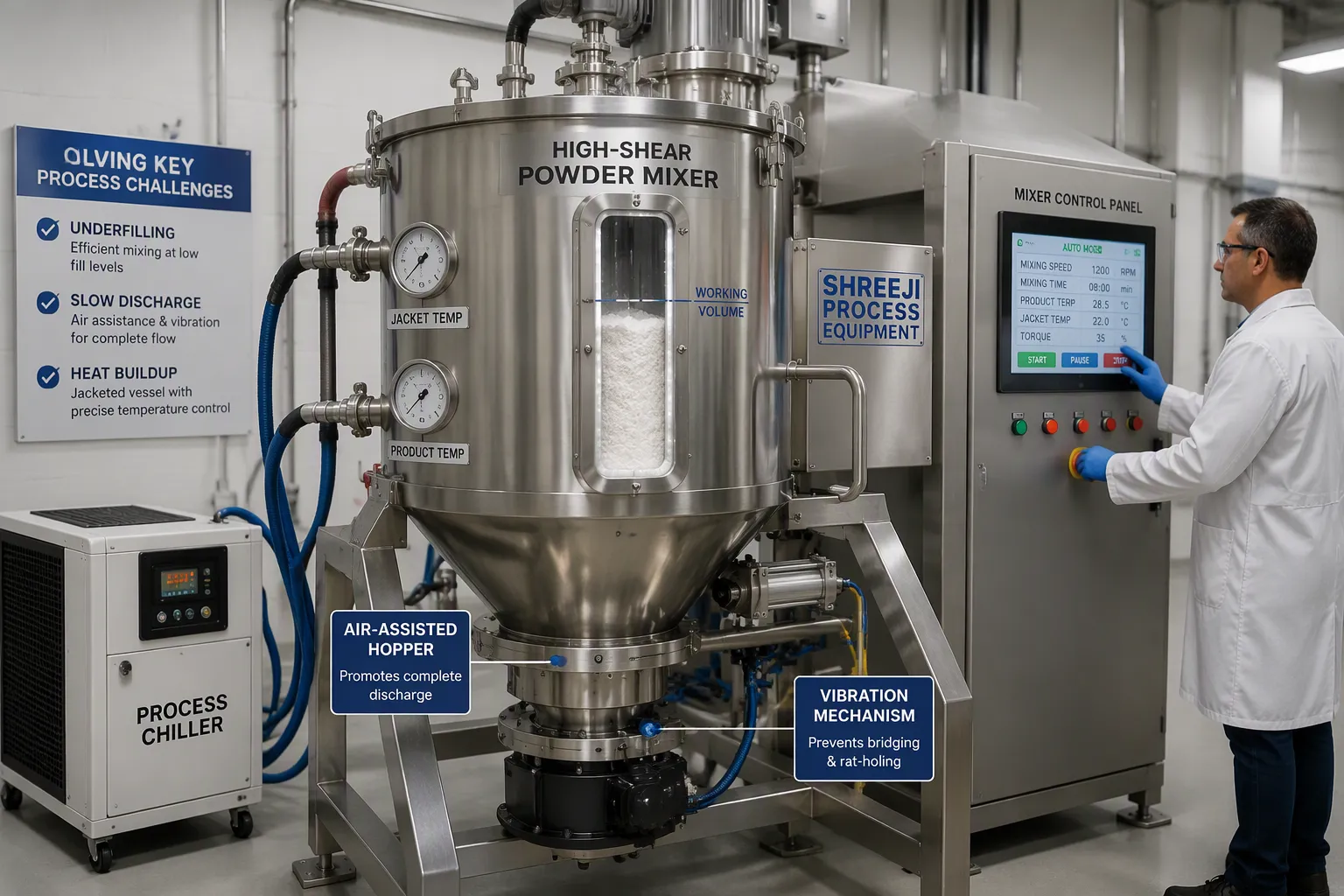
Underfilling, Slow Discharge, and Heat Buildup
Underfilling wastes the capacity you paid for. When you load a vessel below its working range, dead zones form where powder never meets the shear zone. Fill the mixer to its rated working volume, and check the load cell reading against your bulk density figure on every batch.
Slow discharge steals more hours than most plants expect. Sticky powders bridge at the outlet, and operators wait while the vessel drains. Fix the flow at the source with air-assisted hoppers or vibration, and time each discharge to confirm the gain.
Heat buildup deserves equal attention. Friction between fluid molecules during high shear generates excessive temperature rise, especially in closed-system mixers. That heat can cause irreversible viscosity shifts, ingredient degradation, and unwanted chemical or physical changes. Certain high-melt-index powders act as binders when friction or external sources heat them during high shear granulation, which reduces clogging tied to viscous liquid binder systems. Precise control of temperature, moisture, and blade speed improves granulation precision and cuts downstream variability in tablet compression or encapsulation. Use jacketed vessels or external chillers to protect active compounds. A well-managed industrial powder mixer keeps heat inside a safe band.
Loading, Automation, and Optimization
Manual loading limits throughput and adds batch-to-batch variation. Automation closes that gap. Programmable logic controllers coordinate batch loading, mixing cycles, and discharge operations, which reduces manual intervention and batch variability. Sensors enable monitoring and remote control of mixing parameters, and that improves process reliability and compliance with industry standards. Robotic arms automate handling tasks in loading and discharge, which minimizes operator exposure to dust and hazardous materials. Automation of V-type powder mixers ensures batch uniformity, enhances safety in pharmaceutical and chemical manufacturing, and optimizes production throughput.
Air-assisted hoppers condition difficult powders for dependable flow and total discharge. An inner membrane covers the product-contact cone surface, and low-pressure conditioning air or inert gas diffuses through it, aerating the powder so it flows like a liquid and eliminating bridging and rat-holing. The same hopper can serve as a weigh hopper, which removes batch-to-batch variation from material hold-back.
Review your line after installation. Track cycle time, discharge time, and blend consistency, then adjust fill level and speed to lift output efficiency. A bulk powder mixing machine that runs at its rated capacity, batch after batch, returns more value than a larger unit that never fills. Treat industrial mixing equipment as a system, and tune the loading, mixing, and discharge stages together. That habit keeps your industrial powder mixer productive long after the purchase.
Your selection chain moves in one direction: output target, real cycle time, batch size, mixer volume, then type comparison. Follow it in order, and every decision rests on facts instead of guesswork.
Before you buy, check the choice with bulk density testing on each SKU. Confirm discharge performance on a trial run as well. These two checks protect your capacity and your output efficiency.
Treat the purchase as the start, not the finish. Track cycle time and blend consistency after installation, then adjust fill level and speed. A well-chosen industrial powder mixer pays you back for that ongoing attention for years.
FAQ
What is the first number I should confirm before choosing a mixer?
Confirm your hourly output target first. Then test the bulk density of every SKU you plan to run. These two figures drive batch size and vessel volume. A high speed mixer for powder mixing only works as expected when you size it by mass, not liters alone.
How do I know if a mixer is too large for my batch?
Check the fill level against the 40–70% working volume range. A batch that fills less than 30% of the vessel creates dead zones and segregation. You pay for capacity you never use, and blend quality drops at the same time.
Which mixer type suits sticky or cohesive powders?
Tumble and ribbon designs have a hard time with cohesive powders. High shear units break down agglomerates through intense local shear. Vacuum designs help when you need degassing or low-temperature drying. Match the type to how your powder flows, not to its nameplate volume.
How do I fix slow discharge on an industrial powder mixer?
Start with air-assisted hoppers or vibration at the outlet. Sticky powders bridge easily, and every extra minute of discharge cuts your batches per hour. Time each discharge after the fix. An industrial powder mixer only hits its rated output when the vessel drains cleanly and quickly.
Can I validate a mixer choice without a trial run?
No. Ask for a trial on your own powder before you commit. Confirm discharge performance and blend consistency during that run. Bulk density testing on each SKU protects your capacity estimate. A trial removes the guesswork that nameplate figures leave behind.