




Choosing an industrial drying equipment manufacturer involves more than comparing machine prices. Buyers need to evaluate drying technology, material compatibility, manufacturing capabilities, process control, customization options, and after-sales support.
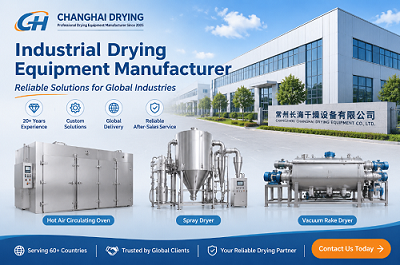
Changzhou Changhai Drying Equipment Co., Ltd. is a Chinese manufacturer of industrial drying equipment, established in 2005. The company provides drying and processing equipment for pharmaceutical, chemical, food, biotechnology, and new energy material applications. Its core product range includes CT-C series hot air circulating ovens, LPG/YPG/ZLPG series spray dryers, and KJG series hollow paddle dryers.
This article introduces Changhai Drying's main equipment, manufacturing capabilities, application experience, and key considerations for selecting an industrial drying system.
1. Company Overview: Industrial Drying Equipment Manufacturing and Customization
Founded in 2005, Changzhou Changhai Drying Equipment Co., Ltd. is based in Zhenglu Town, Changzhou, Jiangsu Province, China, an area known for its drying equipment industry.
The company manufactures industrial drying equipment and develops customized solutions based on material properties, production requirements, and process conditions. According to its company information, Changhai Drying has more than 25 CNC machining machines and an annual production capacity exceeding 300 sets of drying equipment.
Its technical and manufacturing capabilities support equipment selection, process testing, equipment fabrication, installation, commissioning, and after-sales service.
Key Company Capabilities
Equipment manufacturing: Production of industrial drying machines for different material characteristics and processing requirements.
Customized engineering: Equipment configurations tailored to operating temperature, moisture content, material viscosity, throughput, and other process parameters.
Process testing: Trial drying and material testing to help determine suitable equipment and operating conditions.
Installation and commissioning: Technical support during equipment installation, startup, and process adjustment.
International supply: Experience serving customers in overseas markets, including North America, Japan, Russia, the Middle East, Southeast Asia, and Africa.
Changhai Drying reports that it holds quality management, environmental management, and occupational health and safety management system certifications, along with independent import and export rights. Buyers can request current certificates and supporting documentation during supplier qualification.
2. Three Core Industrial Drying Equipment Series
Different materials require different drying mechanisms. Hot air circulation is commonly used for batch drying, spray drying converts liquid feed into powder, and hollow paddle drying is designed for efficient heat transfer to wet solids and pasty materials.
Changhai Drying offers equipment across these three categories.
2.1 CT-C Series Hot Air Circulating Oven
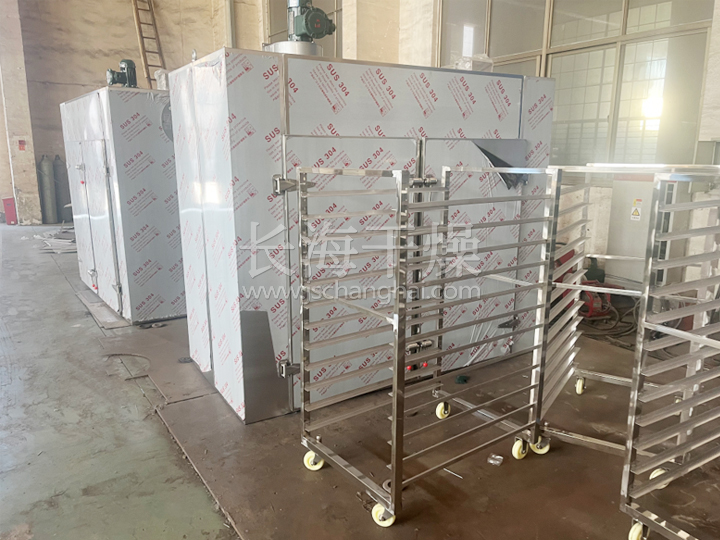
A hot air circulating oven uses heated air and a circulation system to remove moisture from materials placed on trays. It is suitable for batch processing when temperature distribution, drying time, and material handling are important.
The CT-C series hot air circulating oven is equipped with a low-noise, high-temperature-resistant axial fan and an automatic temperature control system. Its enclosed air circulation design supports heat reuse and helps improve thermal efficiency compared with conventional drying rooms.
Key Features
Heating options include steam, electricity, or combined electric and steam heating.
Steam-heated operating temperatures are typically 50–140°C, with a stated maximum of 150°C.
Electric-heated configurations can operate within a stated range of 50–300°C.
Standard tray dimensions are 460 × 640 × 45 mm.
The supplied technical information specifies a temperature difference of approximately ±2°C under applicable operating conditions.
Actual temperature uniformity and drying performance depend on the equipment configuration, loading pattern, airflow, and material characteristics. Buyers should confirm the operating envelope and acceptance criteria for their specific application.
Typical Applications
CT-C series ovens can be used for drying or heat treatment of pharmaceutical raw materials, herbal materials, extracts, powders, granules, dehydrated vegetables, resin materials, and electrical components.
Project Example: Humidity-Controlled Oven for a Research Institute in China
In April 2026, Changhai Drying completed the delivery and acceptance of two customized CT-C-II humidifying ovens for the Changchun Institute of Applied Chemistry, Chinese Academy of Sciences.
The equipment was designed for hydrothermal aging experiments involving alumina spheres measuring approximately 2–5 mm in diameter. The research application required controlled temperature and humidity, corrosion-resistant construction, and flexible experimental programming.
The customized configuration included:
Operating conditions of 90°C ± 5°C and relative humidity of 80% ± 5%.
A stated maximum absolute humidity of 165 g/kg.
304 stainless steel construction for the main chamber components, excluding the structural frame.
Reinforced stainless steel trays with an open design to support airflow through the material.
A DCS-based control system with editable experimental programs.
Integrated heating, humidification, circulation, and exhaust moisture control.
The project included equipment manufacturing, delivery, installation, commissioning, and operator training. According to the supplied project information, the equipment underwent a 72-hour simulated-load test before shipment, followed by on-site calibration.
This project illustrates why laboratory and research applications may require more than a standard drying oven: humidity control, corrosion resistance, programmable operating profiles, and documented performance can all affect equipment selection.
2.2 LPG, YPG and ZLPG Series Spray Dryers
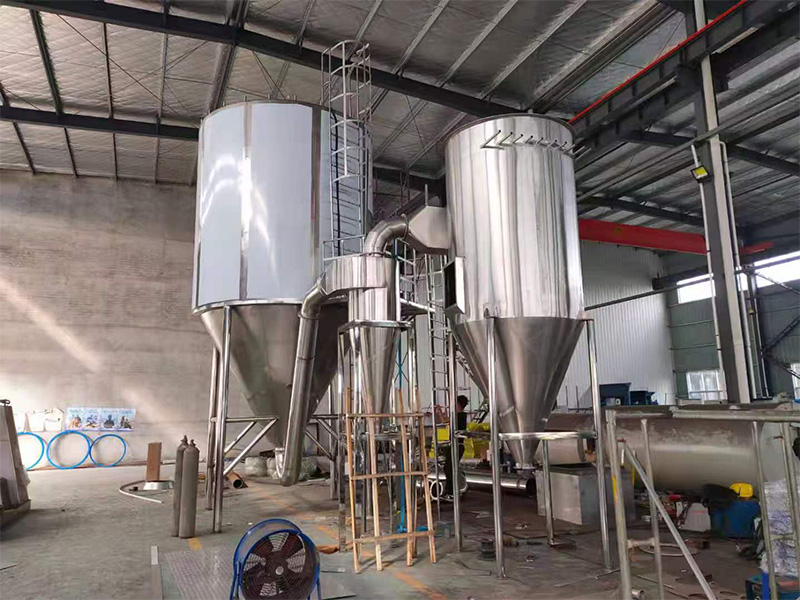
Spray drying converts a liquid feed into powder by atomizing the liquid into droplets and bringing them into contact with a drying gas. Because the droplets have a large surface area relative to their volume, moisture can evaporate rapidly.
Changhai Drying offers several spray dryer configurations for different feed properties and production requirements.
| Series | Main Configuration | Typical Applications |
|---|---|---|
| LPG | High-speed centrifugal spray dryer | Solutions, emulsions, suspensions, and suitable liquid feeds |
| YPG | Pressure spray dryer or spray-cooling configuration | Applications requiring pressure atomization and control over powder characteristics |
| ZLPG | Spray dryer designed for traditional Chinese medicine extracts | Herbal extracts and other suitable heat-sensitive liquid materials |
Key Advantages of Spray Drying
Rapid moisture removal: Atomization promotes rapid heat and mass transfer.
Powder production in one process: Suitable liquid feeds can be converted directly into powder or granules without separate grinding and sieving in many applications.
Adjustable powder properties: Particle size, bulk density, and residual moisture can be influenced by feed concentration, atomization conditions, inlet temperature, outlet temperature, and other process variables.
Flexible material applications: Spray drying can be used for food ingredients, amino acids, extracts, chemical products, catalysts, and selected ceramic materials.
The final powder properties depend on feed composition, viscosity, solids content, heat sensitivity, and operating conditions. Pilot testing is recommended when product activity, solubility, particle size, or recovery rate is critical.
Project Example: LPG-100 Spray Dryer for Amino Acid Production
In May 2026, Changhai Drying completed the delivery, installation, and commissioning of an LPG-100 centrifugal spray dryer for a biotechnology company in Jiangxi, China. The equipment was integrated into an amino acid fermentation-liquid drying process.
Amino acids and other biological ingredients may be sensitive to prolonged heat exposure. The customer needed a process capable of producing a consistent powder while improving production efficiency and reducing material losses.
The project configuration included:
304 stainless steel for product-contact components.
A centrifugal atomization system.
Adjustable inlet and outlet temperature settings.
Process adjustments for feed flow and atomization conditions.
A wall-deposition prevention arrangement.
Cyclone and bag-filter powder recovery.
Automatic interlocks and alarms for selected operating faults.
The delivery scope included equipment installation, commissioning, process adjustment, and operator training. The supplied case information reports that the system entered stable production and improved powder handling and product consistency.
For similar projects, buyers should confirm the feed's solids content, viscosity, required evaporation capacity, powder specifications, and exhaust treatment requirements before selecting a spray dryer.
2.3KJG Series Hollow Paddle Dryer
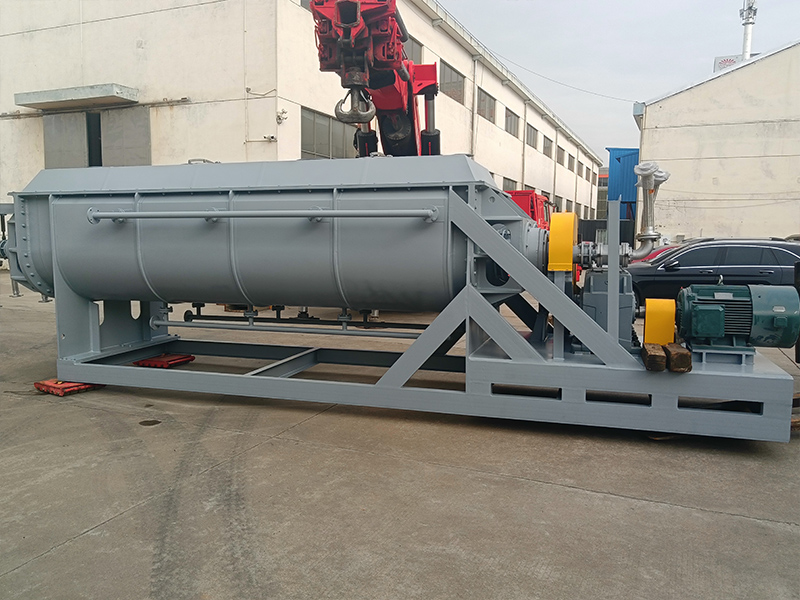
A hollow paddle dryer is an indirect-heating dryer that transfers heat through heated surfaces rather than relying primarily on a large flow of hot air. Hollow rotating paddles agitate the material while providing additional heat-transfer area.
The KJG series is designed for wet solids, pastes, sludges, and other materials that may benefit from indirect heating and continuous processing.
Key Features
Hollow wedge-shaped paddles provide heating surfaces and mix the material during operation.
The self-cleaning action of the paddles can help reduce material buildup on heat-transfer surfaces.
Jacket and hollow-paddle heating can increase the effective heat-transfer area within a compact machine.
Depending on the configuration, the equipment can operate continuously or in batches.
Indirect heating can reduce the volume of process air required and may simplify dust collection or exhaust handling.
The supplied technical information gives a heat-transfer-medium temperature range of approximately −40°C to 250°C, subject to the selected configuration and process conditions.
Changhai Drying lists applications in chemical processing, food production, petrochemicals, industrial sludge treatment, and new energy materials. Potential feed materials include filter cakes, mineral-processing residues, selected chemical salts, and other suitable wet solids.
Project Example: 100 m² Hollow Paddle Dryer for Battery Materials
In June 2026, Changhai Drying delivered a KJG hollow paddle dryer with a stated heat-transfer area of 100 m² to a new energy materials producer in Shandong, China. The system was designed for continuous drying of lithium battery cathode precursor material.
The application presented several challenges: wet material could agglomerate, excessive temperatures could affect material quality, and dust-containing exhaust could increase environmental control requirements.
The project configuration included:
316L stainless steel for material-contact components.
A twin-shaft hollow paddle structure.
Indirect heating through the jacket and hollow paddles.
Automated control of paddle speed, feed rate, heating-medium temperature, and exhaust pressure.
Enclosed, negative-pressure operation with exhaust handling.
Selected explosion-protection and over-temperature protection features for the customer's operating requirements.
The supplied project report states that the configuration was designed to improve heat transfer, limit material exposure to high temperatures, and support continuous processing. Its reported thermal efficiency and energy-saving figures are project-specific and should not be assumed to apply to every hollow paddle dryer installation.
For battery material applications, buyers should also evaluate product contamination risks, material reactivity, oxygen exposure, residual moisture requirements, sealing, and the compatibility of all material-contact surfaces.
Looking for the Right Industrial Drying Equipment?
Share your material properties, processing capacity, and target moisture content. Changhai Drying can help assess suitable drying technologies for your application.
Request an Equipment Consultation3. Manufacturing Capability and Quality Assurance
Reliable industrial drying equipment depends on more than the drying technology itself. Fabrication accuracy, material selection, welding quality, control-system integration, and pre-delivery testing all influence long-term performance.
Changhai Drying's reported facilities include production workshops, a research and pilot-testing workshop, CNC machining equipment, sheet-metal processing equipment, polishing tools, and welding equipment.
These resources support the manufacture and customization of drying systems for different industries.
Equipment Customization and Process Testing
Before specifying a machine, the engineering team should understand the material and its behavior during drying. Relevant factors include:
Initial moisture content and required final moisture content.
Particle size, bulk density, viscosity, and solids content.
Heat sensitivity, oxidation risk, and potential material degradation.
Batch size or continuous throughput requirements.
Available heating utilities and site conditions.
Dust collection, exhaust treatment, and process safety requirements.
Cleaning, corrosion resistance, and product-contact material requirements.
Where material behavior is uncertain, laboratory or pilot-scale testing can help establish suitable process conditions and reduce the risk of selecting an unsuitable dryer.
Installation, Commissioning, and Technical Documentation
The supplied project cases describe services covering equipment fabrication, delivery, installation, commissioning, and operator training. Depending on the project, supporting documentation may include equipment drawings, electrical schematics, material certificates, inspection records, operating procedures, and maintenance instructions.
Buyers should confirm the actual documentation package, factory acceptance tests, site acceptance criteria, and commissioning scope in the technical agreement.
4. After-Sales Support and Spare Parts
Drying equipment is often an important part of a production line. Maintenance response time and spare-part availability can therefore influence operating continuity.
Changhai Drying describes a service model covering technical consultation, equipment installation, troubleshooting, maintenance, and spare-parts supply.
A stated two-year free warranty for the referenced project equipment.
Online technical consultation and troubleshooting support.
Spare parts for common components, such as fans, heating elements, atomizers, and sensors.
Remote guidance and on-site engineering support, subject to the applicable service agreement.
Warranty periods, response commitments, spare-part availability, and travel arrangements should be confirmed in writing for each order, especially for overseas projects.
5. How to Choose the Right Industrial Drying Equipment Manufacturer
Selecting the right supplier begins with the process requirement rather than the machine name. A suitable dryer should meet the material specifications, throughput target, operating conditions, and maintenance expectations of the production line.
| Evaluation Factor | Questions to Ask |
|---|---|
| Material properties | Has the supplier evaluated moisture content, viscosity, heat sensitivity, and material behavior? |
| Drying technology | Is hot-air, spray, indirect-heating, vacuum, or another process appropriate for the material? |
| Production capacity | Can the proposed equipment meet the required batch size or hourly throughput? |
| Product quality | What final moisture, particle size, bulk density, or other acceptance criteria can be demonstrated? |
| Construction materials | Are the product-contact materials compatible with the material and cleaning process? |
| Process control | Which operating parameters can be adjusted, recorded, and monitored? |
| Safety and environmental controls | Are dust collection, exhaust treatment, inerting, or explosion protection required? |
| Testing and commissioning | Can the supplier provide material trials, performance tests, and documented acceptance criteria? |
| Service and spare parts | What warranty, remote support, on-site service, and spare-parts arrangements are included? |
A qualified manufacturer should be able to explain why a particular drying method is suitable, identify its operating limitations, and propose a configuration based on the customer's actual process conditions.
6. Why Consider Changhai Drying for Your Project?
Changhai Drying combines several industrial drying technologies with equipment customization and project delivery services. Its product portfolio allows buyers to evaluate different approaches according to material properties and production objectives.
Multiple drying technologies: Hot air circulating ovens, centrifugal and pressure spray dryers, and hollow paddle dryers.
Industry-specific configurations: Equipment for pharmaceutical, chemical, food, biotechnology, and new energy material applications.
Customized engineering: Options based on temperature, humidity, moisture content, material-contact requirements, and production capacity.
Project support: Assistance with equipment selection, testing, manufacturing, installation, and commissioning.
Technical service: Operating guidance, maintenance support, and spare-parts supply according to the agreed service scope.
The most suitable configuration depends on the material, required output, operating conditions, and project budget. Buyers should evaluate equipment specifications and documented test results alongside the supplier's manufacturing and service capabilities.
Need a Customized Drying Solution?
Discuss your material characteristics, target moisture level, heat sensitivity, and production requirements with the Changhai Drying team.
Discuss Your Project Requirements7. Request an Industrial Drying Solution
If you are sourcing an industrial drying equipment manufacturer for a pharmaceutical, chemical, food, biotechnology, or battery-material project, provide the following information when requesting a quotation:
Material name and basic properties.
Initial and target final moisture content.
Required batch size or hourly processing capacity.
Heat sensitivity, oxidation risk, and any special handling requirements.
Available heating utilities and site conditions.
Required control functions, material-contact standards, and environmental protection measures.
These details help the engineering team assess equipment suitability and recommend a more appropriate configuration.
Contact Changhai Drying
Looking for a hot air circulating oven, industrial spray dryer, hollow paddle dryer, or a customized drying system? Contact Changzhou Changhai Drying Equipment Co., Ltd. to discuss your process, request technical specifications, or arrange a material test.
Request a QuoteFinal equipment selection and performance should be confirmed through technical evaluation, material testing where appropriate, and an agreed project specification.